Boatmen’s Savings Bank — Vice President
St. Louis Gas Light Company
Belcher Sugar Refining Company
George S. Drake represents the kind of interconnected financial and industrial leadership that quietly powered the growth of St. Louis during the decades following the Civil War. Though not as publicly celebrated as some of the city’s great merchants or manufacturers, Drake occupied positions that placed him at the intersection of banking, utilities, river commerce, and heavy industry—precisely the institutional framework upon which modern St. Louis was being constructed.
Born in Hartford, Connecticut, on October 11, 1825, Drake came to St. Louis with his parents in 1827, when the city was still little more than an ambitious western river town. He was educated in private schools and at Kemper College before entering commercial life at an early age. Like many rising businessmen of nineteenth-century St. Louis, Drake’s career evolved alongside the city itself. He initially worked in mercantile pursuits, eventually becoming associated with Manny, Drake & Company, dealers in boots and shoes, before gradually shifting toward finance, investment, and institutional management.
By 1875, Drake resided at 2807 Locust Street, in the Lucas and Garrison neighborhood—a district increasingly populated by civic leaders, businessmen, clergy, industrialists, and professionals whose combined efforts shaped the trajectory of St. Louis during its years of greatest expansion.
His listing as vice president of Boatmen’s Savings Bank, located at Second Street and Pine Avenue, placed him inside one of the city’s most important financial institutions. Boatmen’s was far more than a neighborhood bank. It stood among the financial engines fueling the commercial and industrial growth of St. Louis, supplying capital, managing investment, and helping stabilize the rapidly expanding economy of the Mississippi Valley. Men in Drake’s position were entrusted not merely with money, but with confidence, reputation, and judgment—qualities essential in an era when the fortunes of cities could rise or collapse upon speculation and economic panic.
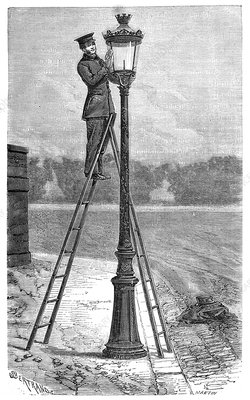
His association with the St. Louis Gas Light Company, headquartered at 511 Olive Street, connected him directly to one of the most transformative infrastructure systems of nineteenth-century urban life. Gas lighting fundamentally altered the operation of American cities after dark. Streets became safer and more navigable. Businesses extended their hours. Factories, hotels, theaters, and public buildings operated with increasing efficiency and sophistication. The gas industry represented modernization itself, and St. Louis’s growing utility network became a visible symbol of the city’s ambitions to stand among the great metropolitan centers of the nation.
The company with which Drake was associated would later evolve into the Laclede Gas Light Company, eventually becoming today’s Spire Inc., one of the region’s enduring corporate descendants from the nineteenth century. In this way, Drake’s professional world extended not only into the commercial life of 1875 St. Louis, but into infrastructure systems that would shape the city for generations.
Compton and Dry’s Pictorial St. Louis also separately indexed Drake through his connection with Belcher’s Sugar Refining Company, located at the corner of O’Fallon and the Levee. This additional association substantially broadens our understanding of his role within the city’s economic network. Sugar refining was a major riverfront industry dependent upon imported raw materials, Mississippi River transportation, rail distribution, warehousing, wholesale commerce, and large-scale industrial processing. It tied St. Louis directly into international trade networks flowing through New Orleans and upriver into the American interior.
Drake’s presence within all three spheres—banking, public utilities, and industrial refining—reveals him not as a narrow specialist, but as one of the interconnected financial-industrial figures helping bind together the operating systems of the city itself.
The later history of the Belcher enterprise illustrates the long arc of that industrial world. In the 1890s, a deep well drilled to provide clean water for the refinery instead produced sulphur-rich mineral water unsuitable for refining sugar but believed to possess medicinal qualities. A private bathhouse and health spa was subsequently constructed upon the site, later evolving into the Belcher Bath and Hotel operation downtown. Over succeeding decades, portions of the property were adapted for food processing, warehousing, and light industrial uses before eventually falling into severe decline during the late twentieth century. By the end, the aging structures housed used paperback book storage and automobile painting operations beneath leaking roofs, failing utilities, and boarded windows before their eventual demolition in 2001.
That evolution—from industrial optimism to adaptive reuse and eventual disappearance—mirrors the broader trajectory of much of old industrial St. Louis.
George S. Drake therefore serves as more than a banker living on Locust Street. He represents an entire class of nineteenth-century civic-industrial operators whose influence crossed multiple sectors simultaneously. Through finance, utilities, and manufacturing, men like Drake helped construct the economic and physical systems that transformed St. Louis into one of America’s great nineteenth-century cities.
LucGar Reflective Addendum
The life of George S. Drake reminds us that cities are not built by isolated individuals working alone within single professions. They emerge through networks of interconnected people, institutions, industries, and shared civic ambitions. Banking supported infrastructure. Infrastructure supported manufacturing. Manufacturing fueled commerce and growth. Behind many of those systems stood individuals whose names are now largely forgotten, yet whose decisions and investments shaped the physical and economic character of their communities for generations.
The Lucas and Garrison neighborhood reveals these hidden connections repeatedly. In studying figures like Drake, we gain insight not only into the mechanics of nineteenth-century urban growth, but also into the importance of long-term civic thinking, institutional cooperation, and investment in the common life of a city.

 George S. Drake
 That evolution—from industrial optimism to adaptive reuse and eventual disappearance—mirrors the broader trajectory of much of old industrial St. Louis.