
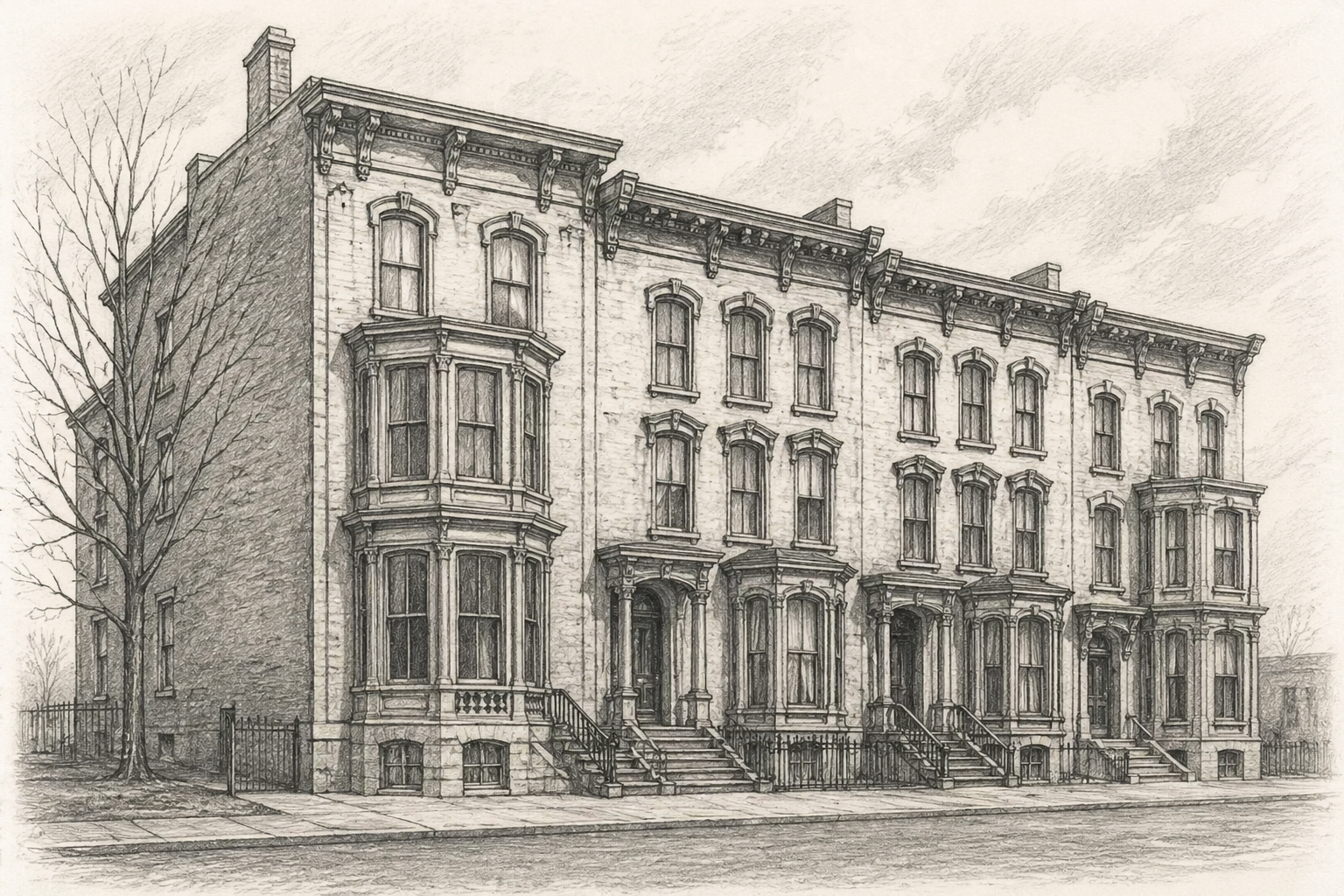
A typical Givens Row Building
Givens Row —
A Microcosm of Rise and Decline in St. Louis
In 1884, architect and builder Joseph W. Givens designed what became known as Givens Row, a distinguished series of Italianate townhouses along Delmar Boulevard in St. Louis. At the time of their construction, these homes represented a confident statement about the future of the city—orderly, elegant, and built for an upwardly mobile class seeking proximity to commerce while retaining a sense of refinement.
Givens Row was not merely architecture; it was aspiration in brick and stone.
The Promise of Urban Order
The Italianate style—arched windows, bracketed cornices, and vertical emphasis—was intentionally chosen. It conveyed sophistication and cosmopolitan identity, aligning St. Louis with eastern cities like Boston and Philadelphia. Developments like Givens Row reflected a broader trend:
-
Dense but orderly urban living
-
A blending of residential dignity and commercial accessibility
-
Confidence in long-term neighborhood stability
This was the late nineteenth-century city at its most optimistic. The same civic energy that built grand homes along Lucas, Garrison, and Washington was also shaping corridors like Delmar.
The Forces of Change
Yet, within a few decades, the trajectory began to shift. Givens Row—like many carefully planned developments—became vulnerable to forces far larger than architecture:
-
Westward migration of wealth toward newer suburbs
-
Industrial encroachment and zoning shifts
-
Transportation changes, especially streetcars and later automobiles
-
Social and economic fragmentation, including racial divisions following the Civil War era
What had been a desirable, cohesive residential block gradually lost its original identity. Ownership patterns changed. Maintenance declined. The architectural unity that once signaled prestige became, over time, a relic of a past no longer economically supported.
A Pattern Repeated Across the City
Givens Row is not an isolated story—it is a pattern repeated across St. Louis:
-
Lucas and Garrison’s elite homes
-
Washington Avenue’s residential blocks
-
Countless smaller streets built with intention and pride
Each followed a similar arc:
Creation → Prosperity → Transition → Decline
What makes Givens Row particularly valuable to your work is its clarity. It compresses this entire cycle into a single, visible streetscape.
The Deeper Interpretation
Givens Row forces a harder question—one that aligns directly with the Lucas and Garrison philosophical premise:
If these neighborhoods were built with intelligence, resources, and civic pride… why did they not endure?
The answer is not architectural failure. It is human and systemic change.
-
Cities evolve faster than structures
-
Economic priorities shift
-
Communities fragment when cohesion is lost
The buildings remained—but the shared purpose that sustained them did not.
LucGar Reflective Addendum
Givens Row stands today not simply as a remnant of nineteenth-century design, but as a quiet warning. The men who built these homes believed they were creating something lasting—an ordered and prosperous urban environment. Yet within a generation, the forces of movement, industry, and division began to unravel that vision.
The lesson is not that cities inevitably decline, but that they require continual stewardship. Architecture can express aspiration, but it cannot preserve it. The fate of Givens Row reminds us that the true strength of a neighborhood lies not in its buildings, but in the shared values and commitments of the people who inhabit them.