
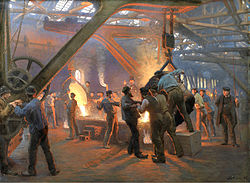
Iron Industry Foundry

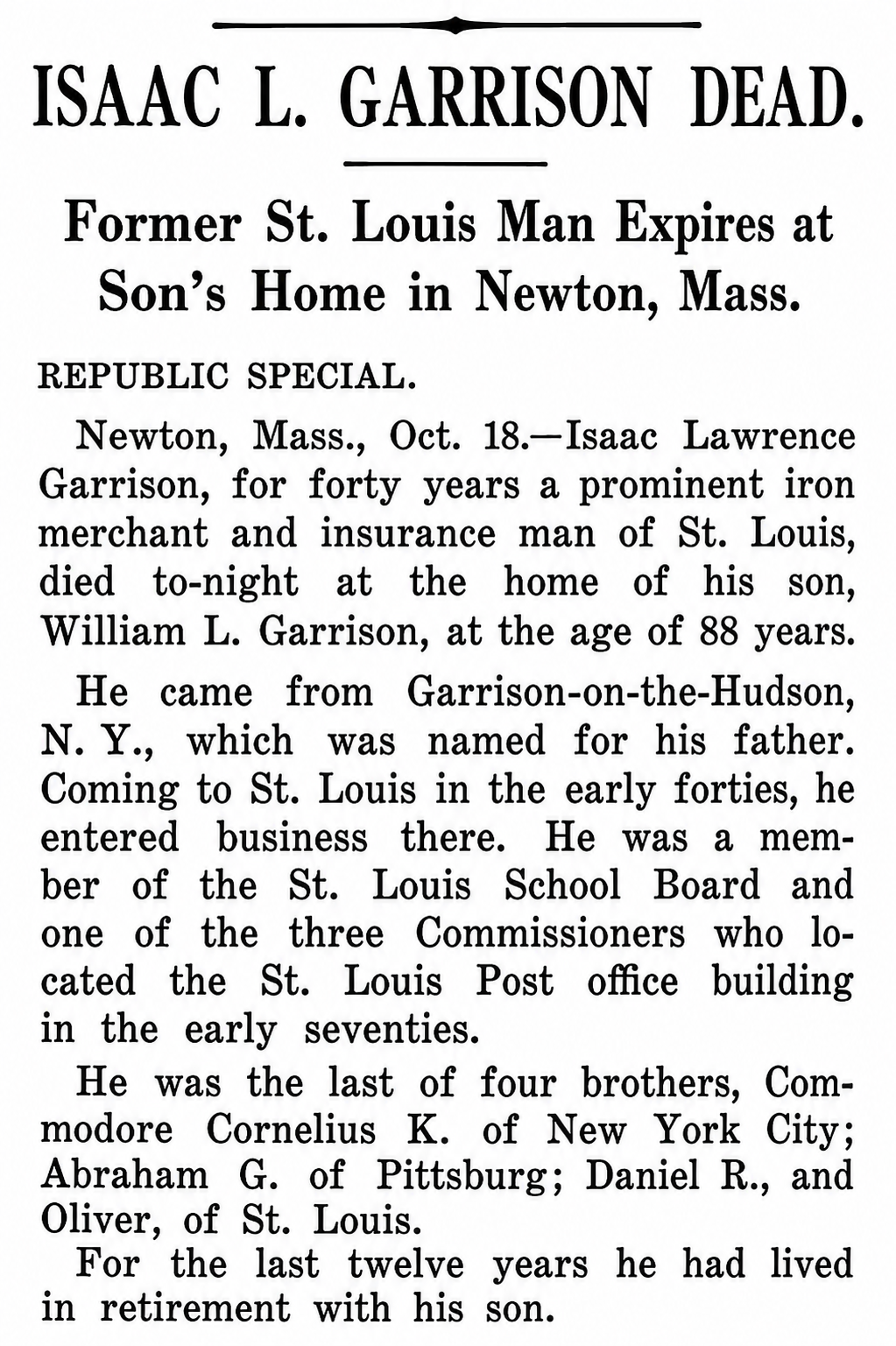
Isaac L. Garrison
816 Garrison Avenue

Garrison-on-the-Hudson, New York

Died: October 16, 1905 (aged 87–88)
Newton, Middlesex County, Massachusetts

Buried: Bellefontaine Cemetery
Saint Louis, City of St. Louis, Missouri

Isaac L. Garrison stands as one of the more economically versatile and symbolically significant residents within the Lucas and Garrison neighborhood of 1875. His professional life traced the physical and financial development of St. Louis itself, moving through the iron trade, the marble and stone industry, and eventually into the expanding world of insurance and finance. In many respects, his career mirrors the broader maturation of St. Louis during the decades following the Civil War, as the city evolved from a frontier-oriented commercial center into one of America’s great industrial metropolises.

By 1875, Garrison resided at 816 Garrison Avenue, a fitting address for a man whose own name had become associated with one of the city’s principal residential corridors. The avenue represented stability, prosperity, and westward urban expansion. Large brick homes, landscaped lots, and socially prominent residents increasingly characterized the district, reflecting the confidence and ambition of postwar St. Louis society.

Garrison’s earliest professional associations appear rooted in the iron trade, one of the foundational industries of nineteenth-century urban growth. During the decades after the Civil War, iron was indispensable to nearly every aspect of American expansion. Railroads stretched westward across the continent. Bridges spanned rivers previously considered barriers to commerce. Warehouses, mills, factories, and commercial blocks rose rapidly throughout St. Louis. Men engaged in the iron business occupied an essential position within this network of development.
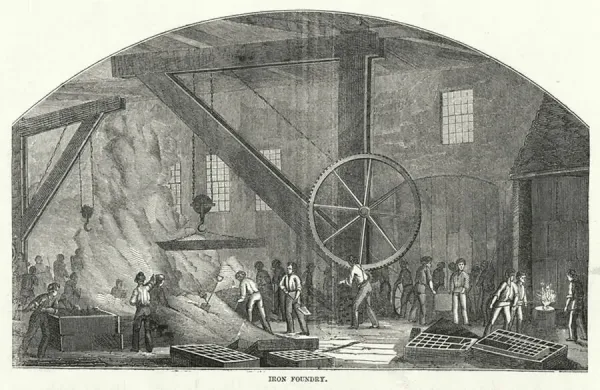
Late Nineteenth Century Iron Foundry

Whether operating as a dealer, merchant, or intermediary, Garrison participated in the circulation of materials that literally constructed the modern city. Iron was the skeleton of industrial America, and individuals involved in its trade often became closely connected to railroads, builders, engineers, and civic development interests. His work placed him among the class of businessmen who enabled the transformation of St. Louis from a river town into a major inland manufacturing and transportation center.
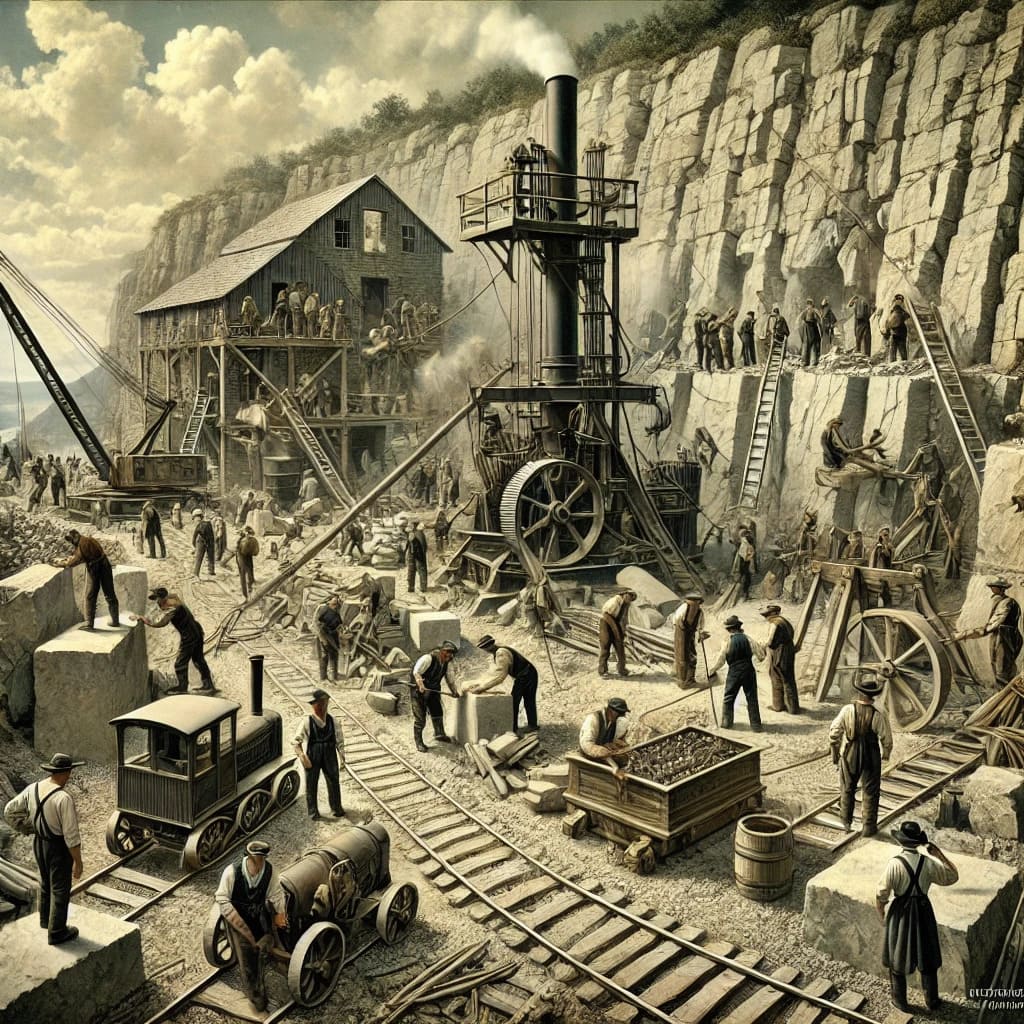
Late Nineteenth Century Marble Mining
By the late 1860s and early 1870s, however, Garrison’s professional interests appear to have broadened into the marble and stone trade. This transition is especially revealing, for it reflects a subtle but important shift within the culture of the city itself.

Iron represented expansion and utility. Marble represented permanence.

As St. Louis matured, its wealthier citizens increasingly sought architectural refinement and enduring public expression. Marble became a preferred material for churches, civic structures, cemetery monuments, banks, and elegant residences. It symbolized cultural aspiration and stability. Through involvement in the marble trade, Garrison participated not simply in construction, but in the shaping of the city’s visual identity.

His business likely connected eastern quarries and suppliers with St. Louis builders and consumers eager to project sophistication and permanence. Churches required altars and interior stonework. Families commissioned elaborate monuments for rural cemeteries such as Bellefontaine. Public institutions sought impressive facades reflecting civic confidence. Men like Isaac Garrison helped supply the materials through which St. Louis expressed its growing ambition.

In many ways, his career progression from iron into marble reflects the very evolution of the city itself:

Iron built St. Louis.

Marble memorialized it.

Like many successful businessmen of the era, Garrison eventually expanded beyond material trades and into the financial structures supporting urban growth. By the 1870s, records indicate involvement in insurance and related financial enterprises. This was a common progression among established nineteenth-century businessmen who had accumulated both capital and practical experience in commerce and construction.

Insurance during this period formed a critical component of urban stability. Fire remained a constant threat in rapidly growing cities. Commercial expansion required underwriting, risk assessment, and financial confidence. A man experienced in iron, construction materials, and property development possessed valuable insight into structural integrity, commercial hazards, and property valuation.

Garrison’s movement into insurance therefore represented not a departure from his earlier career, but rather its logical culmination. He evolved from supplying the materials of urban growth to helping safeguard the economic system built upon them.

His residence at 816 Garrison Avenue symbolized the success and permanence that such professional evolution could achieve. The neighborhood surrounding Lucas and Garrison increasingly attracted merchants, industrialists, attorneys, physicians, clergy, and civic leaders whose collective influence shaped the social and economic fabric of St. Louis during the Gilded Age. Garrison’s presence among them reflected decades of successful adaptation within a rapidly changing economy.

Within the broader Lucas and Garrison project, Isaac L. Garrison represents what might best be described as the “transitional industrialist.” He cannot be confined to a single profession or narrowly defined occupation. Instead, his life illustrates the interconnected nature of commerce, industry, architecture, finance, and urban development in nineteenth-century St. Louis.

Through iron, he participated in the city’s expansion.

Through marble, he contributed to its permanence and identity.

Through insurance, he helped stabilize the wealth and infrastructure of the emerging metropolis.

Few residents so clearly embody the layered economic maturation of St. Louis during this transformative period.

LucGar Reflective Addendum

One of the recurring discoveries within the Lucas and Garrison project is the realization that cities are not built by isolated industries, but by interconnected networks of labor, materials, finance, and vision. Isaac L. Garrison’s life illustrates this progression with remarkable clarity.

His story reminds us that urban history is often hidden within the professions that quietly shape everyday life. Iron merchants, marble dealers, and insurance executives rarely dominate public memory, yet they profoundly influence the physical and financial structures surrounding future generations.

In many respects, Isaac L. Garrison became a steward of permanence. He participated in building the framework of St. Louis, refining its architectural character, and protecting the wealth created through its expansion. His life demonstrates how commerce itself can become a form of civic authorship, leaving marks upon a city long after individual names have faded from popular remembrance.