Lucas and Garrison 1875


An Intersection of Saint Louis lives, times and places.

  • Lucas and Garrison Home
    • Why This Project is Important
    • Plate 71 – Then And Now
    • Dry and Compton Maps
    • City of Saint Louis 1875
    • Saint Louis in 1875 from Today’s Perspective
    • 1875 City Statistics
    • Cultural Ethics
    • Resources
  • 104 Plate 71 Research Targets
    • Grid, Sectors & Groups
    • Sector 1 – Group 1
    • Sector 1 – Group 2
    • Sector 1 – Group 3
    • Sector 2 – Group 4
    • Sector 2 – Group 5
    • Sector 3 – Group 6
    • Sector 3 – Group 7
  • Populated Resident Profiles
  • Rabbit Trail Index

Charles H. Buck
2917 Morgan Street

Born: 1822

Died: 1881
St. Louis Missouri

Buried: Bellfountaine Cemetery
St. Louis, Missouri

Married: Caroline W. Mittnacht Buck
March 27, 1851

C. H. Buck Stove Company
Eclipse Stove Works – 720–722 North Main Street
Foundry - 3500 N. 2nd Street

In the industrial expansion of post–Civil War St. Louis, Charles H. Buck emerges not merely as a manufacturer, but as the head of a substantial and far-reaching enterprise. Residing at 2917 Morgan Street within the Plate 71 district, Buck represents that vital class of resident-industrialists whose fortunes—and influence—were forged in production rather than speculation.

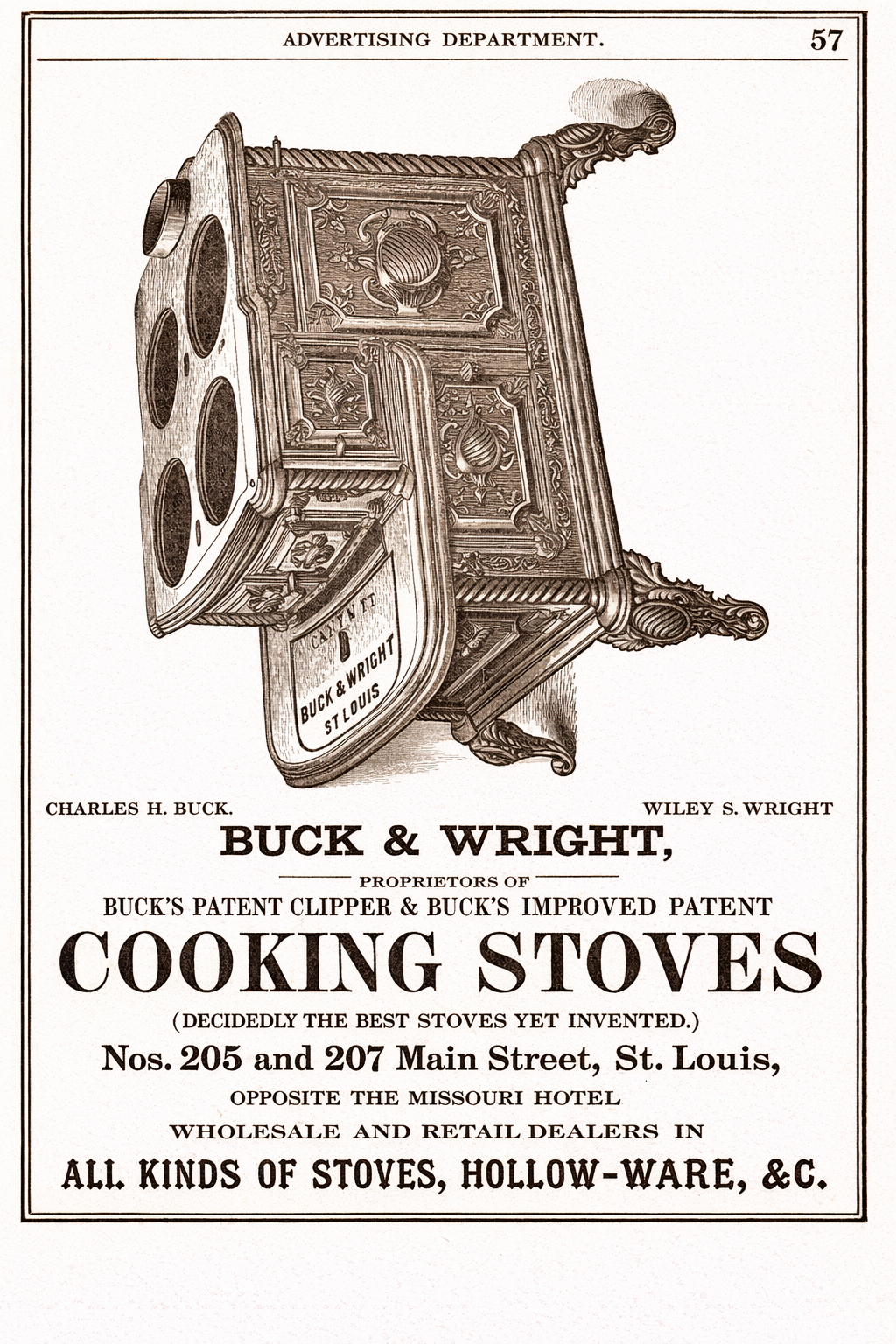
The Eclipse Stove Works, operated under the firm name Buck & Wright, stood at 720 and 722 North Main Street, with an additional foundry at 3500 North Second Street. These were not modest facilities. The Main Street building, constructed of iron and brick, extended 55 feet across and 110 feet deep, rising four stories above a basement. The ground floor housed offices and sample rooms, while upper levels and basement functioned as storerooms. The foundry itself mirrored this scale, extending even deeper and rising to four stories—clear evidence of a vertically integrated manufacturing operation.

g7spvf6MwbqtPF0o67rqrmyxsAk3pOCDy-TieUJm-m9lCJs-hdkzLFR4LapxdtLfOotES6kxPTABHmUOukyN1Rqancssmi0HcVoZ5RkQw83kJr_0MJVHluaPzROG.jpg

What distinguishes Buck’s operation is not simply its size, but its output and reach. The works employed approximately 150 men, a significant workforce by the standards of the day, engaged primarily in the manufacture of cooking and heating stoves, along with hollow ware and general castings. Annual production reached approximately 20,000 stoves, with distribution extending far beyond St. Louis—to the Pacific slope, throughout the North and South, and into the western territories. This places the Eclipse Stove Works firmly within the national marketplace, not merely a regional supplier.
The firm itself dated back to 1849, placing its origins in the earliest phase of St. Louis’s industrial ascent. Following the death of Mr. Wright around the early 1870s, Buck assumed full control of operations, though the established firm name was retained—likely for its commercial recognition and goodwill. This transition marks Buck not as a junior partner, but as the inheritor and continuator of a long-standing industrial concern.

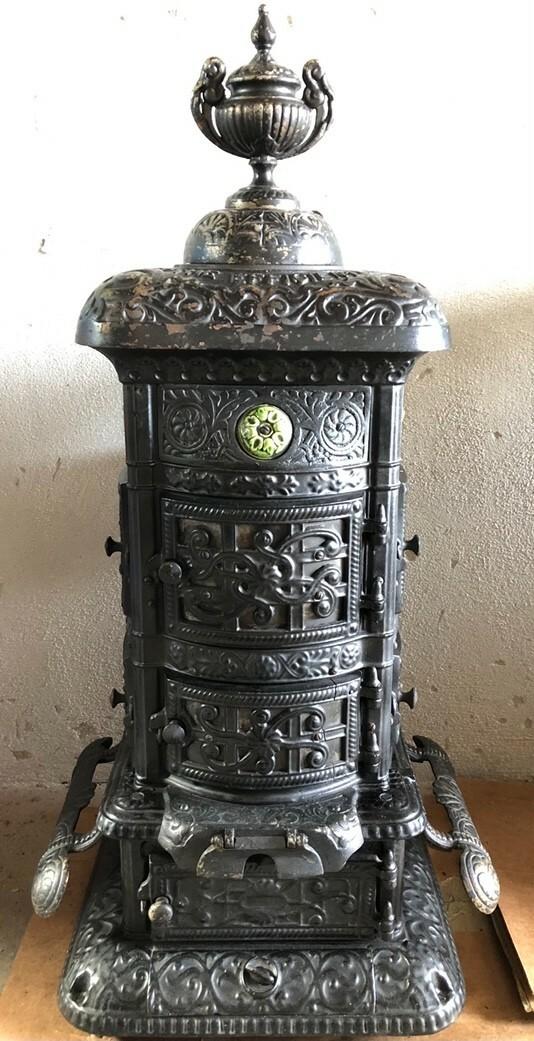
Equally telling is the diversity and branding of the company’s products. Among its cooking stoves were models such as “Buck’s Brilliant,” “Peerless,” “New World,” “Montana,” “Flora,” “Colorado,” and “Prince.” Heating stoves carried equally evocative names—“Lillie,” “Oriental,” “Lady Franklin,” “Fire King,” “Fire Queen,” and “Lady Gay.” These names reflect a mature consumer market in which utility alone was insufficient; identity, aspiration, and aesthetic appeal were integral to sales. The stove had become both a necessity and a statement piece within the American home.

Although the firm operated primarily as a wholesale manufacturer, it maintained a significant retail presence to serve city customers directly. This dual structure—wholesale distribution paired with local retail—demonstrates a sophisticated business model, allowing Buck to operate simultaneously at scale while remaining embedded in the daily life of St. Louis residents.

Industrial Context: Heat, Iron, and Expansion

By 1875, the stove industry was one of the defining expressions of American industrial capability. It required coordination across mining (coal and iron), transportation (river and rail), skilled labor (pattern makers and molders), and sales networks stretching across a rapidly expanding nation.

St. Louis, positioned at the intersection of these systems, was uniquely suited to this trade. Buck’s Eclipse Stove Works exemplifies how the city functioned as a manufacturing hub supplying not only its own population but the broader frontier. Each stove shipped westward carried with it a piece of St. Louis industry—literal warmth exported into newly settled regions.

Interpretive Reflection

Charles H. Buck’s significance lies not in public office or recorded speech, but in scale, continuity, and function. He sustained and expanded a firm that predated the Civil War, employed hundreds, and distributed essential goods across a continent in motion.

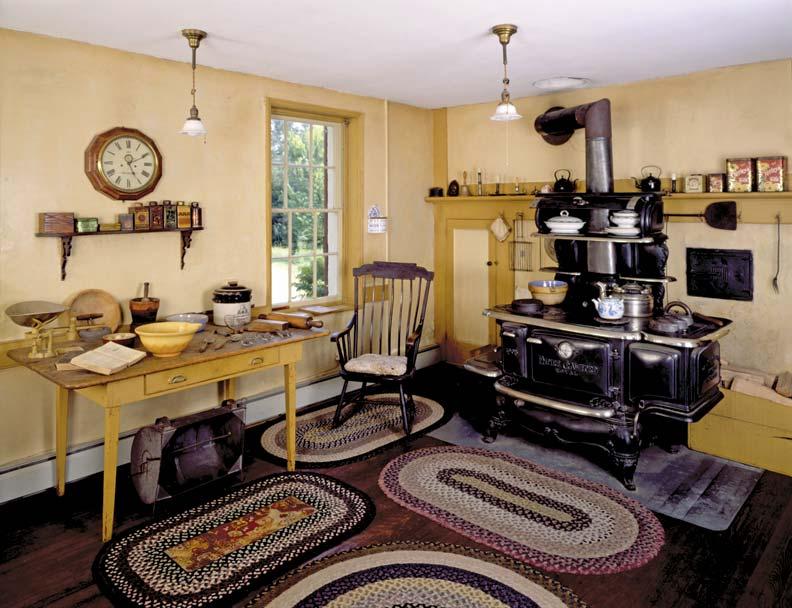
His work was embedded in the most intimate sphere of life—the home. Every stove produced by the Eclipse Works became the center of a household: the place where meals were prepared, rooms were warmed, and families gathered. These were not transient contributions; they were daily, enduring presences.

In studying Buck, we are reminded that the true measure of a city’s growth is not found solely in its prominent names, but in the infrastructure of living created by its الصناعي class—the men who built, forged, and supplied the necessities of life. Through iron, fire, and enterprise, Charles H. Buck helped sustain the rhythm of nineteenth-century St. Louis and extend its influence far beyond its streets.

Lucas and Garrison
copyright 2008-2026
_________________

lucasandgarrison.com

preservedwisdom.org

webstergroveshistorichomes.org

lacledegroveschapel.com

artatthegroves.com

lightcapture.org

Why Should This History Matter?

Lucas and Garrison - 1875
An intersection of Saint Louis
lives, times and places.
_________________________


Wm .S. Wichman - Curator


Copyright 2026 Preserved Wisdom