William D. Baker 2831 Washington Avenue Partner, Gray, Baker & Company
Booksellers, Stationers & Printers
Business Address: 407–417 North 4th Street
In 1875, William D. Baker resided at 2831 Washington Avenue, part of the steadily developing residential corridor extending westward from the commercial heart of St. Louis. His daily work, however, drew him back toward that center, to North Fourth Street, where he was engaged in one of the city’s most essential—if often understated—trades: the production and distribution of printed knowledge.
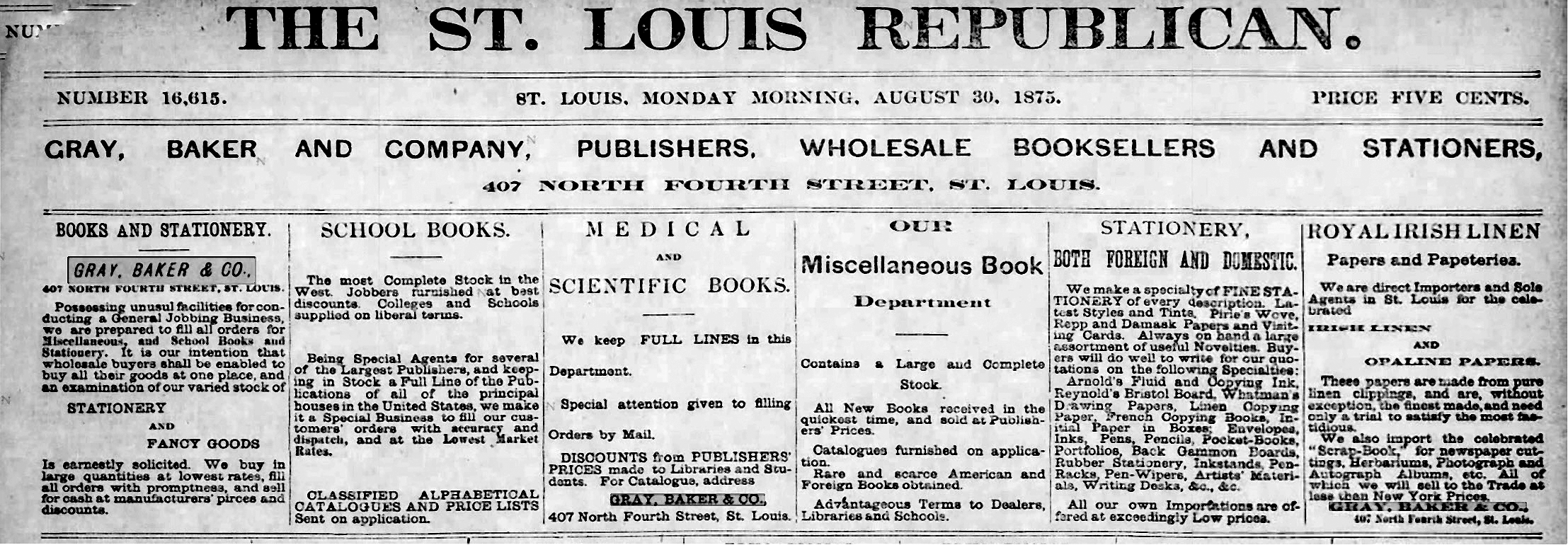
Baker was a partner in Gray, Baker & Company, alongside E. P. Gray and Henry Griffin. The firm operated as booksellers, stationers, and printers, with its place of business located at 407–417 North Fourth Street. This location placed the company squarely within the dense commercial district of the city, among merchants, legal offices, and financial houses whose operations depended upon the steady flow of printed materials.
The scope of Gray, Baker & Company extended well beyond the sale of books. As stationers and printers, the firm likely produced and supplied the ledgers, forms, correspondence materials, and printed documents that sustained the daily functioning of St. Louis’s commercial and institutional life. Newspaper advertisements from the period describe the establishment as a “Mammoth Book House,” offering subscriptions to daily and weekly newspapers, magazines, and periodicals “of every description,” often at discounted publisher rates. Such language suggests not a modest retail shop, but a substantial and well-organized enterprise positioned at the center of the city’s information economy.
Through this work, Baker and his partners occupied a critical role within a rapidly expanding urban system. In an age before electronic communication, the movement of ideas—commercial, legal, educational, and civic—depended entirely upon the printed word. Firms like Gray, Baker & Company served as both distributors and facilitators of that exchange, linking publishers to readers and institutions to the materials required for their operation.
The firm’s involvement in publishing further underscores its significance. Among the works issued by Gray, Baker & Company was Logan Uriah Reavis’s Saint Louis: the Future Great City of the World, a widely circulated volume that promoted the city’s commercial strength and national potential. This publication was more than a local history; it was a bold expression of civic ambition, arguing that St. Louis was destined to become the central metropolis of the United States. By participating in its publication, the firm—and by extension Baker himself—became part of the broader effort to define and promote the identity of the city during a period of extraordinary growth.
Baker’s residence on Washington Avenue reflects the emerging pattern of separation between workplace and home that characterized this era of urban development. While his business operated in the crowded commercial core, his home stood among a growing population of professionals and merchants who sought both proximity to the city’s opportunities and distance from its congestion. This geographic balance mirrors the broader transformation of St. Louis in the decades following the Civil War, as neighborhoods expanded westward in response to increasing prosperity and population.
Although personal details of Baker’s life remain limited in surviving records, his professional position places him firmly within the infrastructure that supported the city’s intellectual and commercial expansion. He was not a manufacturer of goods nor a builder of railroads, but his work enabled both—providing the tools through which transactions were recorded, information disseminated, and ideas circulated.
⸻
Lucas and Garrison Reflective Addendum
William D. Baker’s story invites us to consider the quiet but indispensable role of those who sustain the flow of information within a society. In 1875, St. Louis was not only growing in population and industry; it was growing in complexity. Businesses required records, institutions required communication, and citizens required access to knowledge. All of this depended upon the availability and movement of printed materials.
Through Gray, Baker & Company, Baker stood at this intersection. Every ledger sold, every subscription fulfilled, every volume placed into a reader’s hands contributed to the functioning and advancement of the city. His work reminds us that progress is not achieved solely through grand enterprises or visible achievements, but through the steady support of systems that allow those enterprises to exist.
The firm’s publication of Reavis’s vision of St. Louis as the “future great city of the world” adds another dimension to this role. Baker was not only helping to distribute knowledge—he was participating in the dissemination of belief. The idea that St. Louis could become the central city of the nation was carried, quite literally, through the channels he helped sustain.
History would ultimately take a different course, yet the aspiration itself remains significant. It shaped how the city saw itself and how its citizens understood their place within it. In this sense, Baker’s contribution extends beyond commerce into the realm of civic identity.
The study of figures like William D. Baker reminds us that the past is not only built by those whose names dominate the record, but also by those who enable the exchange of ideas, the keeping of accounts, and the communication of vision. Their work may be less visible, but it is no less essential.