Church of the Holy Communion Washington Avenue at Leffingwell Avenue Episcopal Parish — Established 1869 (Gould’s Directory, 1875)
The Episcopal Church of the Holy Communion emerged in 1869 as a deliberate act of faith and community-building in a growing and shifting St. Louis. Founded on January 24, 1869, by twenty-three communicants meeting in a modest brick schoolhouse near downtown, the parish began with intention rather than prominence.
By June of that same year, the congregation called the Reverend P. G. Robert as its first rector. Under his leadership, the parish moved quickly to establish permanence. Within his first year, Holy Communion purchased property at the corner of Washington and Leffingwell Streets—positioning itself within what would soon become one of the city’s most active and evolving corridors.
Construction of a stone chapel began in June 1870. This initial structure anchored the young congregation physically and spiritually, marking its transition from temporary gathering to established parish presence. Yet even this early investment proved only the beginning. As the congregation grew, so too did its ambitions.
In June 1876, construction began on a larger church building, reflecting both increased membership and rising confidence. Less than a year later, on Easter Eve, March 31, 1877, the new church opened its doors with a service that included the baptism of thirteen new members—a fitting symbol for a parish still very much in formation.
At the moment captured in Compton & Dry’s 1875 Plate 71, the Church of the Holy Communion stood in transition: no longer a fledgling congregation, yet not fully realized in its final architectural form. It was, in essence, a living institution—growing alongside the neighborhood it served.
Its presence on Washington Avenue placed it among merchants, manufacturers, and professionals whose lives were defined by ambition and movement. Within that environment, Holy Communion offered stability—rooted in Episcopal liturgical tradition and providing structure, continuity, and shared identity in a rapidly developing urban landscape.
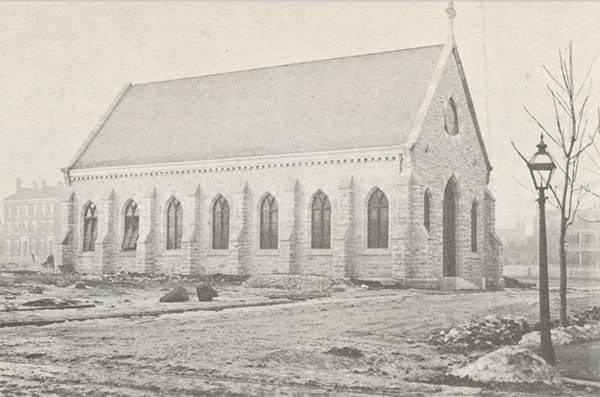
The original Church of the Holy Communion chapel, begun in 1870, stood as a modest but purposeful Gothic Revival structure. Built of stone and defined by a series of narrow lancet windows, the building reflected both the liturgical identity of the Episcopal Church and the practical realities of a young congregation.
The structure was restrained in its execution. It lacked a tower or elaborate ornamentation, instead presenting a simple gabled form with a front-facing entrance. This was a building designed for reverence and durability rather than display.
Its placement on a relatively open corner of Washington Avenue is equally telling. At the time, this section of the city remained in transition—partially developed, with open ground surrounding established structures. The church’s presence marked a forward-looking commitment to permanence in what was still an emerging district.
This chapel served the parish during its formative years until the construction of the larger church building in 1876–1877 signaled the congregation’s maturation and growing role within the neighborhood.

 Church of the Holy Communion