John Porter Capelle
620 Garrison Avenue
Jewelry and Silverware Dealer – 409 North Fourth Street
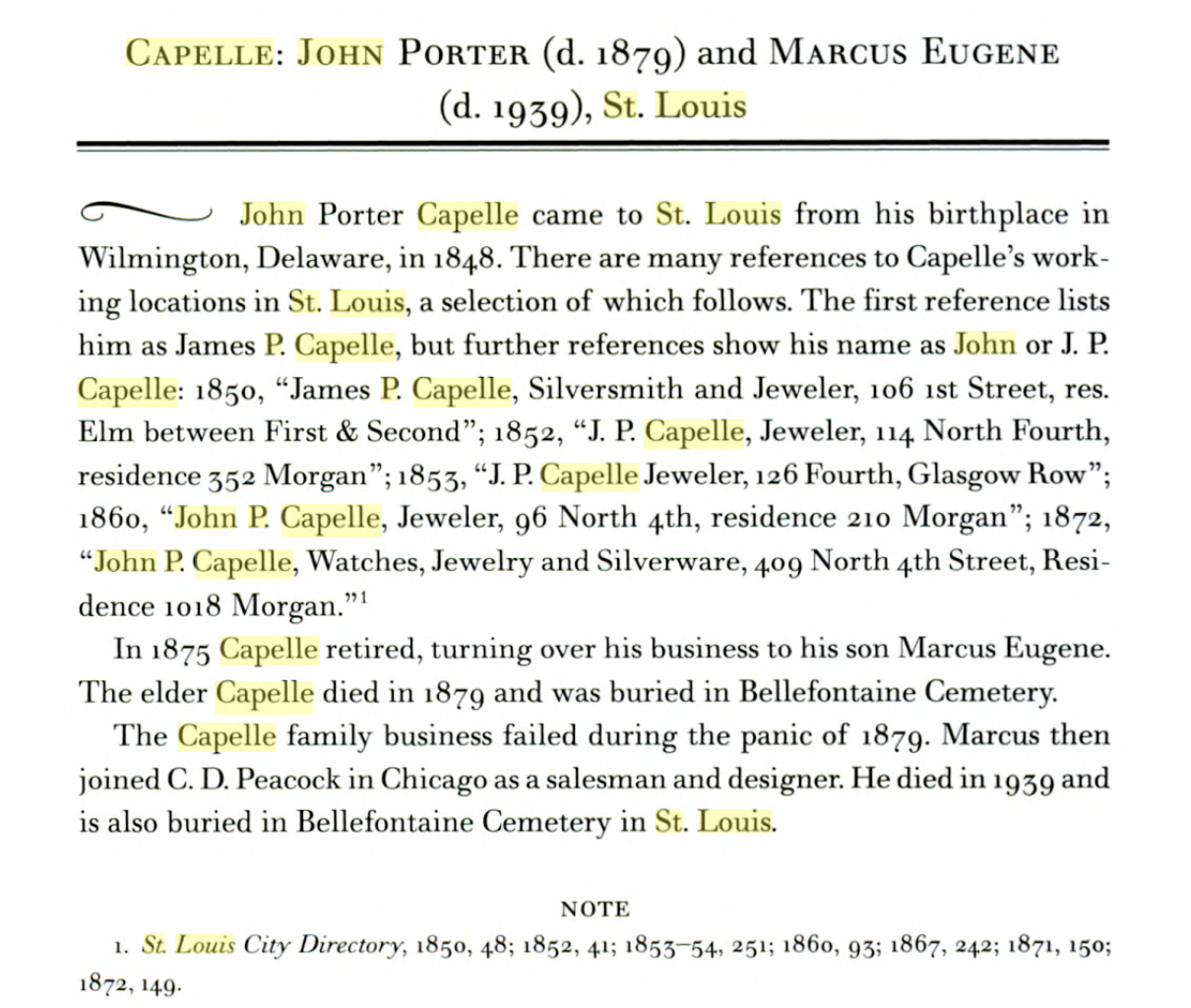
Among the merchants and craftsmen living within the Lucas and Garrison neighborhood in 1875 was John Porter Capelle, a longtime St. Louis jeweler whose career stretched back nearly to the city’s frontier commercial era. By the time his name appeared on Plate 71 at 620 Garrison Avenue, Capelle had already spent more than a quarter century building a respected jewelry and silverware business in downtown St. Louis.
Capelle was born in Wilmington, Delaware, and arrived in St. Louis in 1848, during the city’s explosive period of antebellum growth. He entered the jewelry and silversmith trade almost immediately. Early city directories reveal both the evolution of his business and the rapid commercial development of St. Louis itself. In 1850 he appeared as “James P. Capelle, Silversmith and Jeweler,” located on First Street. Within only a few years he had moved his establishment several times as the city’s business district shifted westward and expanded.
The directory record traces Capelle’s steady rise:
-
1850 – “James P. Capelle, Silversmith and Jeweler”
-
1852 – “J. P. Capelle, Jeweler, 114 North Fourth”
-
1853 – “J. P. Capelle, Jeweler, 126 Fourth, Glasgow Row”
-
1860 – “John P. Capelle, Jeweler, 96 North Fourth”
-
1872 – “John P. Capelle, Watches, Jewelry and Silverware, 409 North Fourth Street”
 These entries reveal more than simple addresses. They document a craftsman who successfully adapted through decades of civic transformation, economic volatility, and the Civil War era while remaining tied to one of St. Louis’s most competitive luxury trades.
By 1875, Capelle had become sufficiently established to retire from active management, turning the business over to his son, Marcus Eugene Capelle. This transition reflected a common pattern among successful nineteenth-century merchant families, where trade knowledge, clientele, and reputation passed from one generation to the next.
The jewelry and silverware business in nineteenth-century St. Louis occupied an important place within the city’s commercial and cultural life. Jewelers were not merely shopkeepers; they were skilled artisans producing and repairing watches, silverware, ceremonial objects, and luxury goods that symbolized refinement and prosperity in a rapidly growing western metropolis. Their clientele included merchants, professionals, clergy, politicians, and the rising urban middle class. Capelle’s long survival in the trade suggests both skill and reputation.
 Yet the Capelle story also reflects the instability of Gilded Age commerce. The economic collapse known as the Panic of 1873 continued to reverberate through the decade, and the Capelle family business ultimately failed during the financial turmoil of 1879. John P. Capelle himself died that same year and was buried at Bellefontaine Cemetery, where many of St. Louis’s leading nineteenth-century citizens were interred.

After the failure of the family firm, Marcus Eugene Capelle relocated to Chicago, joining the noted jewelry house of C. D. Peacock as a salesman and designer. He would remain associated with the jewelry profession for the rest of his life and died in 1939, also buried in Bellefontaine Cemetery in St. Louis.
Though not among the industrial titans of Plate 71, John P. Capelle represents another essential layer of the Lucas and Garrison neighborhood: the skilled merchant-artisan whose work connected St. Louis to national markets, urban sophistication, and the material culture of Victorian America. His life demonstrates how deeply rooted craftsmanship, family enterprise, and upward mobility were woven into the fabric of post–Civil War St. Louis.
 Lucas and Garrison Reflective Addendum
The story of John P. Capelle reminds us that nineteenth-century St. Louis was not built solely by railroad magnates, politicians, or industrial barons. It was also shaped by skilled craftsmen whose labor brought refinement, beauty, precision, and commerce to a growing city. Jewelers and silversmiths occupied an important place in urban life because they created objects tied to memory, status, ceremony, and daily function.
Capelle’s career also illustrates the fragile balance between success and instability during the Gilded Age. A man could spend decades building a respected business only to see it undone by national financial panic and economic collapse. Yet even in failure, the continuity of skill and trade endured through the next generation.
Within the Lucas and Garrison project, profiles like Capelle’s deepen the understanding that Plate 71 was not merely a neighborhood of wealth, but a living ecosystem of professionals, artisans, merchants, reformers, clergy, industrialists, and families whose combined efforts shaped the identity of St. Louis in 1875.