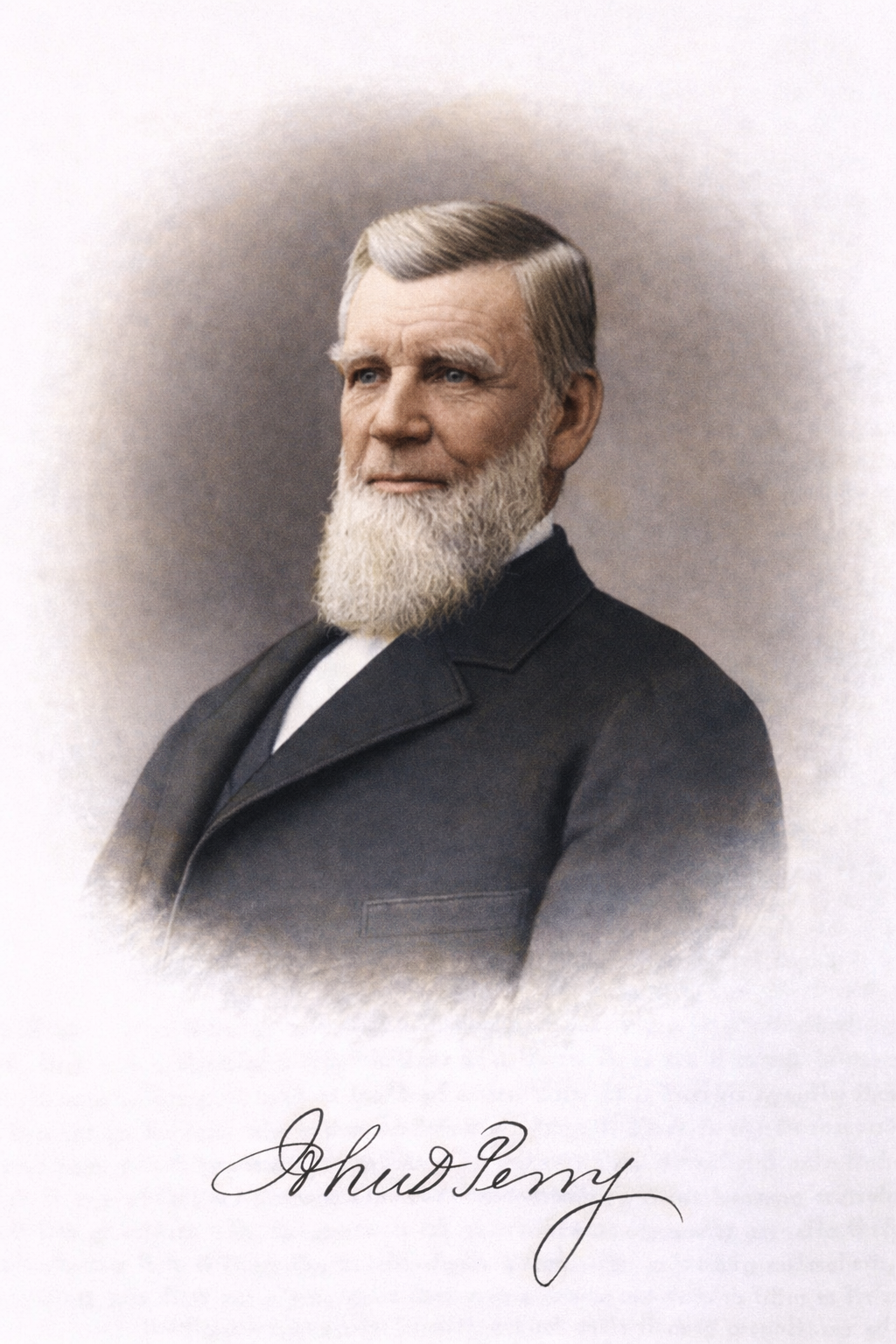
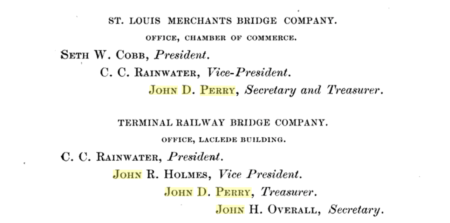
 In the spring of 1854 he decided to seek a still wider field of effort, and. having disposed of his interests in Glasgow, removed to St. Louis and engaged in the manufacturing business with his brother-in-law, W. J. Lewis. He remained a citizen of St. Louis until the end of his life, taking an active and leading part in many enterprises. for his judgment was so wise, and his foresight so clear, that, almost invariably. those who chanced to be his associates in any enterprise which he approved, and in which he jnvested his means, placed him at the head of it-and so it fell to him to carry through a number of undertakings. When, several years before the Civil War, the State Legislature authorized a system of banks, Mr. Perry organized the Exchange Bank, and at a later day he assisted in founding the Laclede Bank; and later still he took a leading part in the construction of the Merchants' Bridge and the terminal system connected with it, and assisted also in establishing the Standard Stamping Company, an important industrial enterprise.
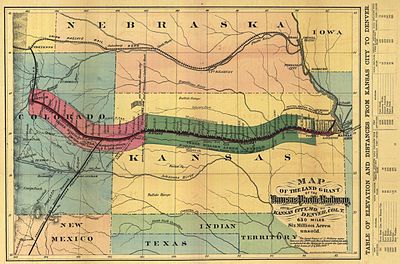
 But the great work of Mr. Perry's life was the construction of the Kansas Pacific Railroad-an enterprise to which he devoted the best energies and the highest capacities of his nature. There were several other leading citizens of St. Louis associated with- him in this undertaking, the most prominent among them being Carlos S. Greeley and Adolphus Meier, but from the time when Mr. Perry invested his private fortune in it, they made him president and committed it to his hands, approving all he did and supporting him in every measure that he proposed for the prosecution of the work. The charter of the road provided for three branches. and that the one first reaching the one hundredth meridian should be the main line. It was Mr. Perry's settled purpose from the beginning to reach the meridian with the Kansas Pacific, and thus make St. Louis the chief gateway through which the great traffic across the continent between the two oceans should pass -and it was not his fault that this object was not accomplished. It was defeated through a suit brought against the company, which impeded its progress and harassed its management, and thus permitted the Omaha branch to secure the prize.