
 Moses Rumsey
2925 Pine Avenue, St. Louis, Missouri
Builder of an Industrial Empire
L. M. Rumsey & Company – Agricultural Implements, Pumps, Fire Equipment, and Industrial Supplies
Born: May, 1836
New York, USA
Died: August 19, 1905 (aged69)
Siasconset, Nantucket County, Massachusetts, USA
Buried: Bellefontaine Cemetery
St. Louis, Missouri
Among the industrial leaders living in the Lucas and Garrison neighborhood in 1875, few were connected to a business as expansive and influential as Moses Rumsey. Residing at 2925 Pine Avenue, Rumsey served as secretary and co-founder of L. M. Rumsey & Company, one of the largest manufacturing and supply houses in the Midwest.
The firm was established in 1860 by brothers L. M. (Leander M.) Rumsey and Moses Rumsey. By 1875, their business had already become a major supplier of agricultural implements, pumps, fire-fighting equipment, machinery, and industrial supplies. Located at 811 North Main Street, the company occupied a strategic position near the Mississippi River and the industrial heart of St. Louis, allowing it to serve customers throughout the expanding American West.
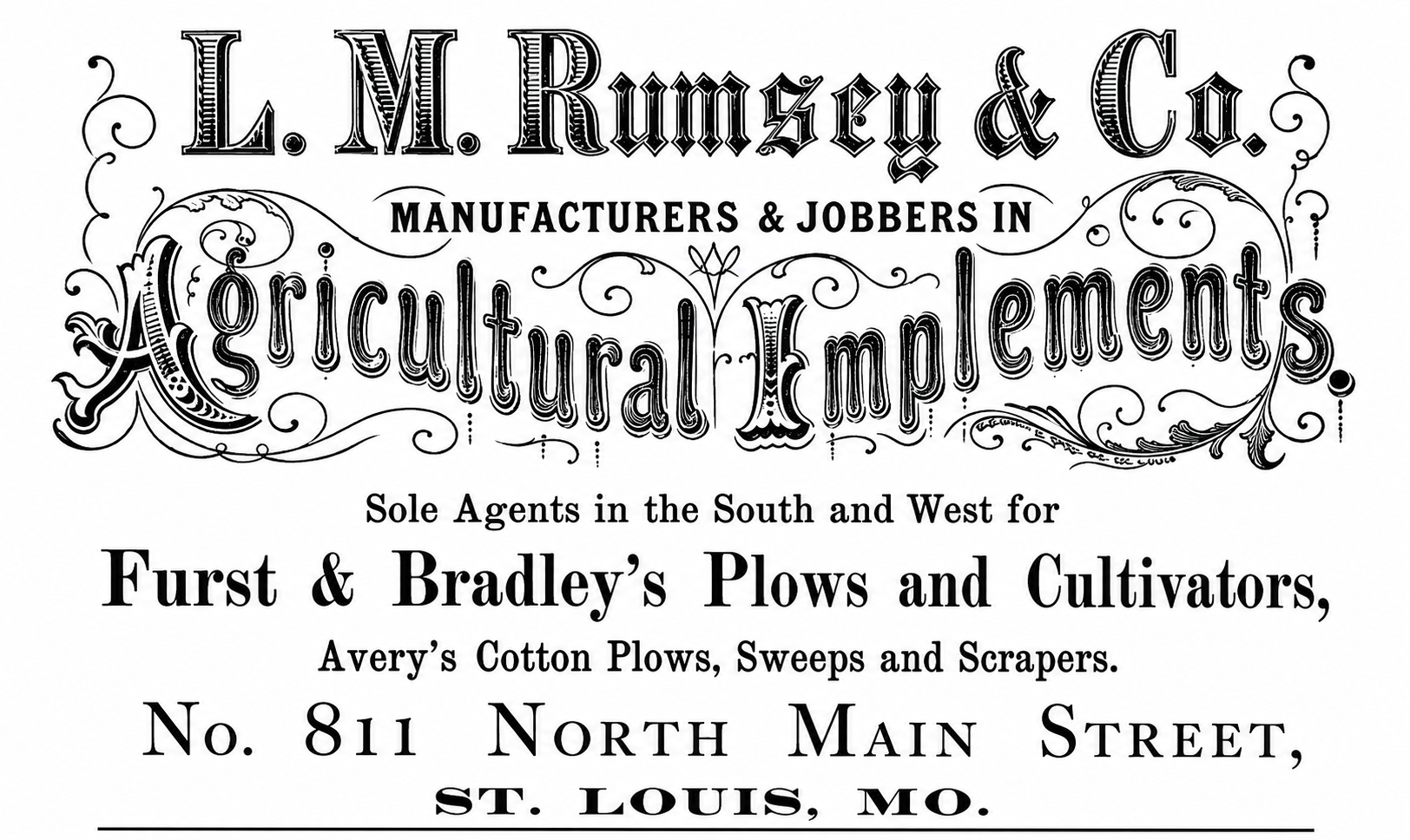
 What began as a hardware and machinery enterprise evolved into one of the most comprehensive industrial supply houses in the nation. The company manufactured and distributed agricultural implements ranging from simple hand tools to sophisticated farm machinery. It supplied pumps, pipe, fittings, steam equipment, railroad materials, foundry supplies, and machinery for nearly every type of industrial operation. The breadth of products carried by the firm reflected the astonishing diversity of industries emerging in St. Louis during the late nineteenth century.
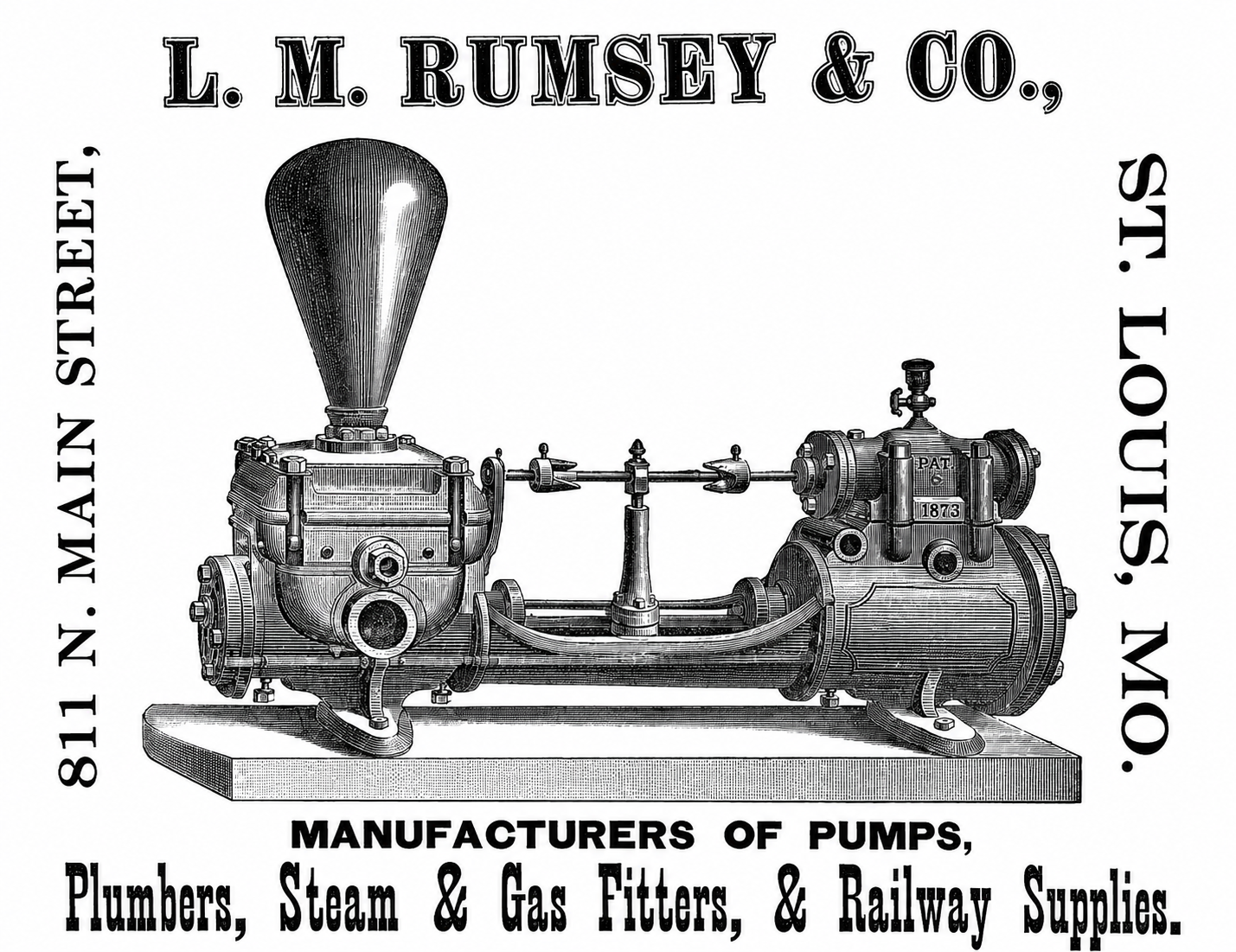
The company also became a major manufacturer of pumps, eventually producing more than a thousand varieties. One of its notable innovations was a machine invented by Leander Rumsey that automated the production of galvanized pump chain, dramatically increasing manufacturing efficiency. Such inventions illustrate how St. Louis businesses increasingly moved beyond simple merchandising into engineering and manufacturing.
In 1880 the enterprise was incorporated as the L. M. Rumsey Manufacturing Company, marking a new stage of growth. Contemporary business accounts described the firm as among the largest establishments of its kind in the world. By the late 1880s, the company reportedly maintained inventory valued at nearly two million dollars, generated annual sales approaching four million dollars, and served approximately ten thousand customers across the United States, Canada, Mexico, Cuba, and South America.
The Rumsey operation occupied nearly two city blocks bounded by Second, Morgan, and Cherry Streets. Its buildings rose three to five stories in height and were illuminated by electric lights powered by the company's own dynamos—an impressive technological achievement during an era when electric lighting was still a novelty. More than 150 skilled workers were employed at the St. Louis facility, while a network of traveling salesmen represented the company throughout North America.
The sheer variety of products offered by the firm is remarkable. In addition to agricultural machinery and pumps, Rumsey supplied fire engines, hose reels, railroad equipment, boilers, machine tools, lead and iron pipe, blacksmithing equipment, foundry supplies, bells, metals, and woodworking machinery. In many respects, the company functioned as a one-stop supplier for the industrial development of the American interior.
Moses Rumsey's residence on Pine Avenue placed him among a remarkable concentration of industrialists, merchants, financiers, and civic leaders who lived in the Lucas and Garrison neighborhood. Their businesses collectively supplied the materials, capital, transportation, and leadership that fueled St. Louis's rise as one of America's great nineteenth-century cities.
Moses Rumsey died before the firm's eventual closure in 1917, but the enterprise he helped build left a lasting mark on St. Louis industry. The company's success demonstrated the city's ability not merely to distribute goods arriving from elsewhere, but to manufacture, innovate, and export products on a national and international scale.
Reflective Addendum
The story of Moses Rumsey illustrates a recurring theme throughout the Lucas and Garrison project: many of the neighborhood's residents were not simply participants in St. Louis's growth—they were builders of the systems that made that growth possible.
Rumsey's company supplied farmers, railroads, factories, contractors, plumbers, foundries, and municipalities. The products moving through his warehouses helped construct the infrastructure of a rapidly industrializing nation. While some Lucas and Garrison residents are remembered for political leadership, philanthropy, or civic institutions, Rumsey represents another path to influence—the creation of an industrial enterprise capable of serving thousands of customers across an entire continent.
His story also reveals the interconnected nature of the neighborhood. Living among bankers, railroad executives, iron merchants, manufacturers, and civic leaders, Rumsey occupied a place within a dense network of relationships that helped drive St. Louis's economic success. The neighborhood was not merely a residential district; it was a concentration of talent, capital, and ambition whose influence extended far beyond the streets of Lucas, Pine, Olive, and Garrison.