
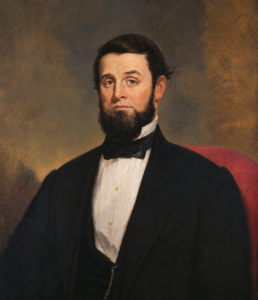
Jesse Arnot
203 Ewing Avenue at Chestnut
Associated Businesses
M. J. Murphy & Company
Arnot’s Livery Stable
Gent’s Furnishing Goods — 402 North Main Street
Livery Stables — 908–912 Chestnut Avenue

Jesse Arnot occupied an important position within the transportation and commercial culture of nineteenth-century St. Louis. By 1875, the city remained fundamentally dependent upon horses—not merely for personal transportation, but for commerce, freight movement, social display, funerary processions, and the daily mechanics of urban life. Before electric streetcars and automobiles transformed the city, the livery stable stood among the most essential institutions in metropolitan America.

Arnot’s association with the celebrated firm of J. & A. Arnot’s Livery Stable placed him directly inside one of the best-known horse and carriage operations in St. Louis. Located on Chestnut Street between Second and Third Streets, the establishment had already achieved regional prominence decades before the publication of the 1875 Gould Directory. Contemporary accounts described it as “one of the features of the Mound City” and praised it as among “the best arranged institutions of the kind in the Western States.”
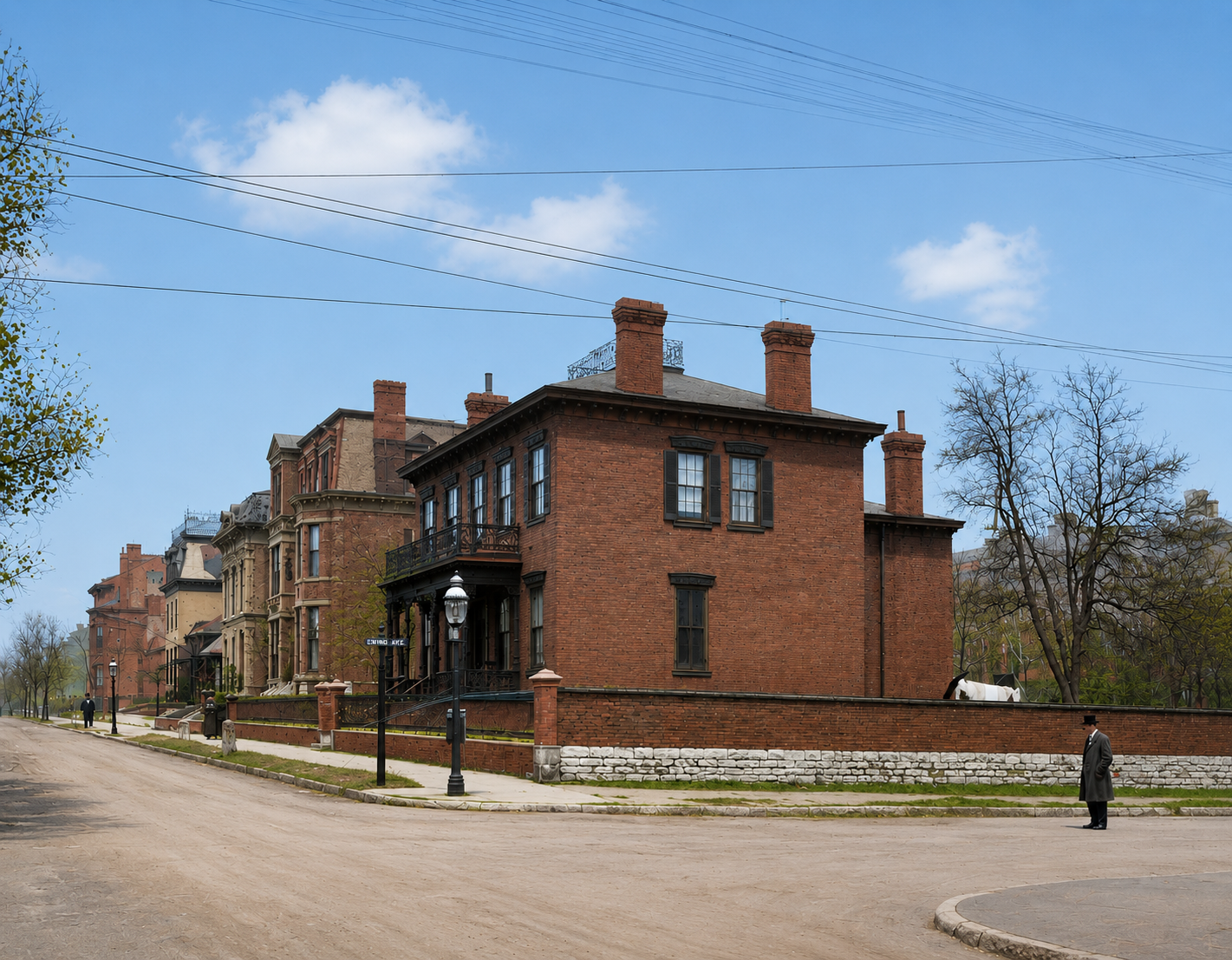
Arnot Family Mansion

The Arnots entered the St. Louis business arena in 1849, during the explosive expansion years that followed the Mexican War and preceded the Civil War. St. Louis was rapidly emerging as the great commercial gateway to the West, and transportation businesses flourished alongside banking houses, wholesale merchants, railroads, and river commerce. The Arnot brothers recognized that urban growth required sophisticated transportation infrastructure long before municipal transit systems became standardized.

Their five-story stable building, erected in 1854, reflected the ambition and confidence of mid-century St. Louis enterprise. According to period descriptions, horses were housed in the basement while the upper floors contained carriage storage rooms, offices, apartments, and even meeting halls. Such multifunctional structures were common in dense urban districts where land values demanded vertical efficiency. The building itself symbolized how deeply horse-powered transportation permeated every aspect of urban life.

The operation went far beyond simply boarding horses. The Arnots maintained elegant carriages and high-quality saddle horses for hire, catering to businessmen, visitors, wealthy residents, and social events throughout the city. Contemporary writers emphasized the beauty and refinement of the equipages supplied by the firm, noting that their carriages could satisfy even the most fashionable patrons seeking stylish transportation for promenades, weddings, or formal appearances.

The stable also maintained funeral carriages and hearses, an important but often overlooked component of nineteenth-century urban services. Before the rise of specialized funeral homes, livery operators frequently handled transportation connected with burials and mourning ceremonies. The Arnots’ reputation for professionalism and courtesy appears to have extended into this sensitive area of civic life as well.

Jesse Arnot’s additional connection with the gent’s furnishing trade at 402 North Main Street suggests a businessman participating in multiple commercial ventures simultaneously, a common pattern among ambitious St. Louis entrepreneurs of the era. The city’s merchants often diversified investments across retail, transportation, manufacturing, insurance, and real estate, creating dense networks of interconnected economic relationships.

The presence of Jesse Arnot on Ewing Avenue also reflects the continuing westward movement of prosperous residents away from the older riverfront districts. Men whose businesses remained concentrated downtown increasingly established homes farther west in neighborhoods that offered quieter residential environments removed from the congestion, noise, smoke, and odors of the central commercial corridor. The Lucas and Garrison district represented precisely this transitional zone of upwardly mobile middle- and upper-class St. Louis life.

The significance of a major livery concern in 1875 cannot be overstated. Nearly every commercial activity in the city depended upon horse-powered mobility. Railroads terminated in freight yards that still required wagons for local distribution. Wholesale merchants depended upon draymen and carriage services. Social standing was often publicly displayed through the quality of one’s horses and carriage. Even emergency response, medical transportation, and municipal functions depended upon stable operations.

Within only a few decades, however, the entire world represented by Arnot’s Livery Stable would begin to disappear beneath electric transit systems, mechanized delivery networks, and eventually the automobile. Jesse Arnot therefore belonged to the final great generation of businessmen whose fortunes and daily operations remained tied to the horse-powered city.

LucGar Reflective Addendum

The story of Jesse Arnot reminds us how completely nineteenth-century urban civilization depended upon systems that modern observers rarely consider. Entire industries, architectural forms, occupations, and social customs revolved around the care, movement, and management of horses. Transportation in 1875 was not merely a convenience—it was the circulatory system of the city itself.

What appears at first glance to be “just a livery stable” was in fact a sophisticated logistical enterprise supporting commerce, social life, funerals, travel, and the physical movement of an expanding metropolis. The Arnots helped power the daily operation of St. Louis during one of its great eras of growth and confidence.

Their story also illustrates one of the recurring themes emerging throughout the Lucas and Garrison project: progress was not created by isolated individuals operating independently, but by interconnected networks of merchants, industrialists, transporters, builders, and civic participants whose combined efforts shaped the trajectory of the city.