
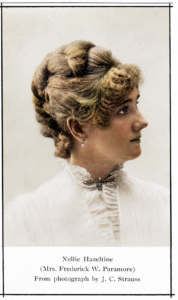
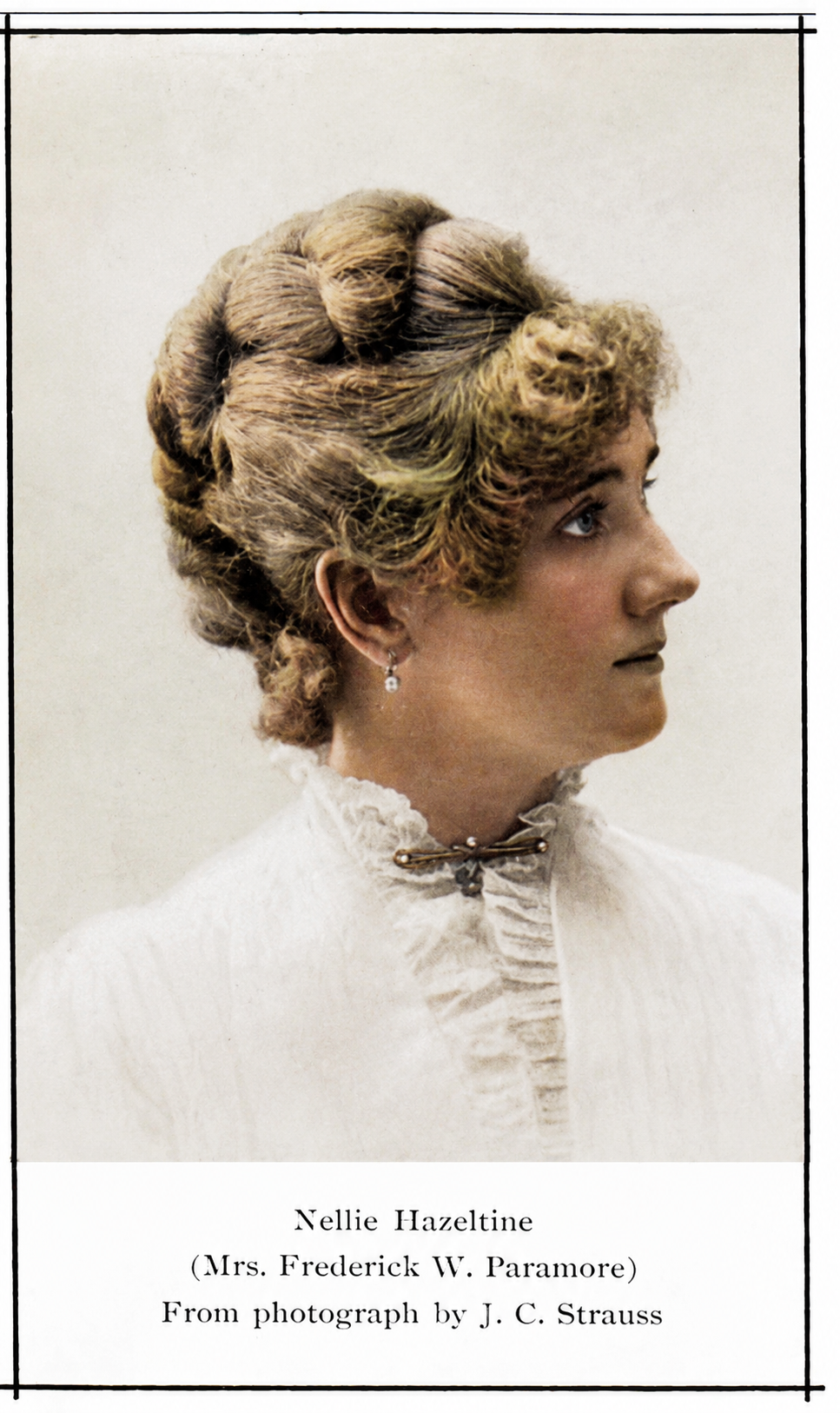
 Nellie Hazeltine Paramore
2731 Pine Avenue
Daughter of Captain William B. Hazeltine
Graduate of Mary Institute, 1873
“The Belle of St. Louis”
Born: November 20, 1857
Saint Louis, City of St. Louis, Missouri
Died: February 22, 1884 (aged 26)
Saint Louis, City of St. Louis, Missouri
Buried: Bellefontaine Cemetery
Saint Louis, City of St. Louis, Missouri, USA
Few individuals connected to the Lucas and Garrison neighborhood more vividly illuminate the social and cultural world of Gilded Age St. Louis than Nellie Hazeltine Paramore. Though only seventeen years old in 1875 and still living within her parents’ household at 2731 Pine Avenue, Nellie Hazeltine would soon become one of the most publicly admired women in nineteenth-century St. Louis society — a figure whose beauty, intelligence, refinement, and tragic early death transformed her into a lasting civic legend.
Born in St. Louis on November 20, 1857, Nellie was the only daughter of Captain William B. Hazeltine and Sarah Ellen “Sallie” Chamblin Hazeltine. She grew up within the prosperous and increasingly sophisticated environment of post–Civil War St. Louis, where successful merchant families sought not only commercial advancement, but also social refinement, education, and cultural accomplishment.
By the time of her graduation from Mary Institute in 1873, Nellie Hazeltine had already attracted unusual admiration within St. Louis society. Contemporary descriptions of her appearance survive in language so extravagant that they almost seem literary invention. Yet the consistency of these accounts strongly suggests that she genuinely possessed a striking physical presence that deeply impressed those who encountered her.
One contemporary writer recalled her graduation appearance in almost poetic terms:
“Her red gold hair seemed to reflect some of the sun’s own glory, and with the marvelous delicacy of her skin, the deep wine color of her eyes, and the classic perfection of her features, there can be little doubt that she was… the most beautiful woman ever born west of the Mississippi.”
Such descriptions became central to the mythology that gradually surrounded her. Yet contemporaries repeatedly emphasized that Nellie Hazeltine’s popularity rested upon far more than beauty alone.
She was described as:
-
intellectually gifted,
-
widely read,
-
fluent in French,
-
musically accomplished,
-
socially gracious,
-
and notably kind toward other women.
One observer wrote:
“Women in every rank of life had for her a tender attachment.”
Another remarked that she possessed an unusual ability to inspire admiration without envy:
“Those with whom she came in contact experienced rather a sense of personal gratification in the contemplation of her gifts than any desire to despoil her of them.”
In many respects Nellie Hazeltine became the embodiment of elite St. Louis society during the late nineteenth century. Writers of the era frequently portrayed St. Louis as a unique blending of:
-
French refinement,
-
Southern hospitality,
-
and mercantile prosperity.
One especially revealing passage declared:
“Of such a civilization Nellie Hazeltine has unquestionably been the fairest product.”
The statement is significant because it transforms Nellie from merely a beautiful young woman into a symbolic representation of St. Louis itself during its Gilded Age ascent.
Her growing social prominence soon extended far beyond Missouri. Newspapers throughout the country followed her appearances, rumored courtships, travels, and social activities with extraordinary fascination. In many ways she became one of the earliest true social celebrities associated with St. Louis — a figure whose public image was shaped and amplified through the rapidly expanding newspaper culture of the late nineteenth century.
Among the many stories surrounding Nellie Hazeltine, none attracted greater national attention than reports linking her romantically with Samuel J. Tilden.
According to contemporary accounts, Nellie first attracted Tilden’s attention while presenting military colors during a competitive drill event attended by her father. The elderly bachelor politician reportedly became deeply captivated by the young St. Louis beauty. Whether exaggerated or entirely sincere, rumors of Tilden’s admiration for Nellie spread rapidly during the intensely contested presidential election of 1876.
One account observed:
“The sentimental side of public opinion was satisfied… with the report that he was soon to be married to Miss Hazeltine.”
That statement reveals how fully Nellie Hazeltine had entered national public consciousness. Americans following the disputed Hayes-Tilden election also found themselves following romantic speculation surrounding the candidate and the celebrated young woman from St. Louis.
Yet despite endless social attention and numerous suitors, Nellie remained unmarried until December 2, 1881, when she wed Frederick W. Paramore, son of railroad executive Colonel J. W. Paramore, president of the Texas and St. Louis Railroad.
A contemporary observer later remarked:
“When Nellie settled down by marrying Frederic Paramore it was a loss to journalism.”
The statement was only partially humorous. By the early 1880s newspapers had already discovered the enormous public appetite for stories involving beauty, romance, wealth, and elite society. Nellie Hazeltine became one of the first St. Louis women whose personal life was followed with a degree of fascination resembling modern celebrity culture.
Tragically, the story ended almost as suddenly as it had risen.
On February 22, 1884, Nellie Hazeltine Paramore died at only twenty-six years of age shortly after childbirth. Her infant son survived only a few days longer.
The reaction within St. Louis was immediate and emotional. Newspapers covered every detail of her illness, funeral arrangements, floral tributes, and mourning ceremonies. One memorial account later recalled:
“The entire city of St. Louis mourned her loss.”
Another observed that visitors to St. Louis still made pilgrimages to her grave years after her death. Her burial at Bellefontaine Cemetery became itself part of the mythology surrounding her life and memory.
Today Nellie Hazeltine Paramore stands as far more than a society beauty frozen within nineteenth-century sentimentality. Through her story can be seen the emergence of:
-
elite women’s education,
-
Gilded Age social culture,
-
celebrity journalism,
-
political fascination,
-
public mourning,
-
and the civic self-image of late nineteenth-century St. Louis itself.