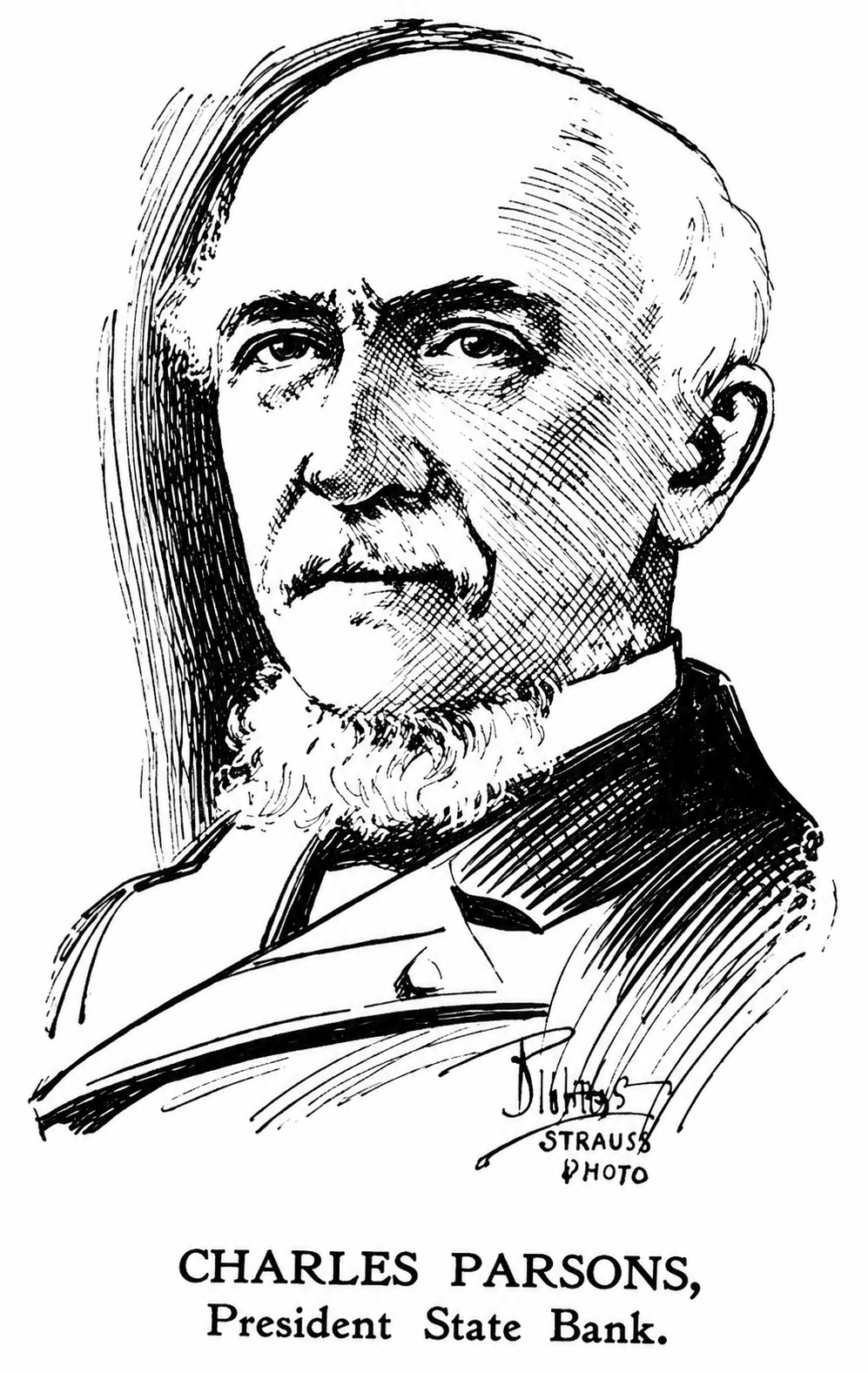
Parsons, Charles
2804 Pine Avenue
President, State Savings Association
Banker, Financier, Civic Leader
Born: January 24, 1824
Homer, Cortland County, New York
Died: September 15, 1905 (age 81)
Wequetonsing, Emmet County, Michigan
Buried: Bellefontaine Cemetery
Saint Louis, City of St. Louis, Missouri
Among the most influential financial leaders residing within the Lucas and Garrison neighborhood in 1875 was Charles Parsons, a nationally respected banker whose career intertwined with the commercial, political, philanthropic, and cultural development of St. Louis during the late nineteenth century. Living at 2804 Pine Avenue, Parsons occupied a position of immense influence within the city’s financial establishment and belonged to the remarkable concentration of civic leadership that characterized the Lucas and Garrison district during its peak years.
Charles Parsons was born at Homer, Cortland County, New York, on January 24, 1824, the third son of Lewis B. Parsons and Lucina Hoar Parsons. His family lineage reached deep into early American history. His grandfather, Captain Charles Parsons, served throughout much of the Revolutionary War, participating in campaigns from Ticonderoga and Valley Forge to Yorktown, where he was severely wounded. The Parsons family further traced its ancestry to Cornet Joseph Parsons, one of the early settlers and landholders of Massachusetts in the seventeenth century.
Parsons’s father became a successful merchant and civic leader in Gouverneur, New York, with a strong interest in education and public affairs. Those influences shaped the younger Parsons, who received an academic education before entering mercantile and banking pursuits in New York. After experience in commercial houses and banking institutions in Buffalo, he moved westward in 1851 to Keokuk, Iowa, where he established a successful banking business during the explosive economic growth of the Mississippi Valley.
The outbreak of the Civil War altered the course of his career. Parsons volunteered for Union service, was commissioned captain, and eventually promoted to lieutenant-colonel because of his exceptional administrative abilities. During the war he was placed in charge of army rail and river transportation centered at St. Louis, one of the most strategically critical logistical centers in the Union war effort west of the Mississippi River. The role required immense organizational skill and connected Parsons directly to the transportation and industrial infrastructure that made St. Louis indispensable to Union victory.
Near the close of the war, Parsons entered St. Louis banking permanently when he became cashier of the State Savings Association, later known as the State National Bank of St. Louis. In 1870 he was elected president, a position he retained continuously until his death in 1905. Under his administration the institution became one of the strongest and most respected financial organizations in the city. Contemporary accounts emphasized the remarkable stability of the bank during decades marked by periodic national financial panics and economic uncertainty.
Parsons’s stature soon extended well beyond his own institution. For twenty-two consecutive years he served as president of the St. Louis Clearing House Association, helping coordinate and stabilize the city’s banking system. His influence became national in scope when he was twice elected president of the American Bankers’ Association, an extraordinary distinction that reflected the high esteem in which he was held by financial leaders across the country. In 1893 he presided over the World’s Congress of Bankers and Financiers at the World’s Columbian Exposition in Chicago, confirming his place among the foremost banking authorities in the United States.
So highly regarded was Parsons that his name was frequently mentioned as a possible Secretary of the Treasury. Though he reportedly declined political advancement, civic leaders repeatedly turned to him during moments of public crisis. In 1892, amid widespread concern regarding St. Louis municipal finances following a major defalcation, Parsons temporarily accepted the office of city treasurer in order to restore confidence and stabilize the city’s financial operations until a permanent solution could be established.
Parsons also occupied a significant place within the broader institutional networks of St. Louis. For many years he served as vice-president and director of the Pulitzer Publishing Company, publishers of the St. Louis Post-Dispatch. This connection placed him within the interconnected circles of finance, journalism, politics, and civic reform that increasingly shaped the direction of the city during the Gilded Age.
Like many of the most influential residents of the Lucas and Garrison district, Parsons viewed civic responsibility as an obligation accompanying wealth and influence. Contemporary accounts repeatedly emphasized his generosity and support for charitable, educational, and religious causes. He was especially active in the work of the St. Louis Provident Association, which aided the poor and promoted self-help among struggling families.
Following the death of his wife, Martha A. Pettus Parsons, in 1889, he endowed and established the Martha Parsons Hospital for Children in her memory. This act of memorial philanthropy reflected a broader pattern among elite St. Louis families of the era, whose charitable institutions often became lasting civic legacies.
Parsons was also known as a cultivated and intellectually curious man. He assembled a notable collection of paintings and works of art acquired during repeated European travels. In 1894 and 1895 he undertook a journey around the world and later published a privately circulated volume of travel observations and sketches. His interests reflected the broader cultural aspirations of late nineteenth-century St. Louis, as the city increasingly sought recognition not merely as a commercial center, but as a place of refinement, education, and artistic ambition.
Politically, Parsons was a prominent Republican and liberal contributor to civic and party causes, though he generally avoided seeking office himself. He remained deeply connected to Civil War veteran organizations, including the Grand Army of the Republic and the Loyal Legion. He also maintained close ties to Christ Church Cathedral, where he served as vestryman.
His influence remained substantial even in his later years. During preparations for the 1904 Louisiana Purchase Exposition, President Theodore Roosevelt reportedly consulted with Parsons concerning the financial condition of St. Louis banks and matters affecting the Fair. Such consultation reveals the extraordinary confidence placed in Parsons’s judgment at both local and national levels.
Charles Parsons died at his summer home in Wequetonsing, Michigan, on September 15, 1905, at the age of eighty-one. His death produced widespread public mourning throughout St. Louis financial and civic circles. Contemporary newspapers described him as one of the city’s foremost men—not only in banking, but in philanthropy and civic life. Estimates suggested his fortune approached one million dollars, an enormous sum for the era, though his reputation rested less upon wealth than upon integrity, public service, and steady leadership.
The life of Charles Parsons illustrates the extraordinary concentration of financial, civic, and institutional power that existed within the Lucas and Garrison neighborhood in 1875. Residents such as Parsons did not merely inhabit the district; they helped direct the economic systems, transportation networks, charitable institutions, political organizations, and cultural ambitions that shaped the future of St. Louis itself.

 Parsons, Charles