Second Baptist Church
Beaumont Avenue and Locust Street
Plate 71 — 1875
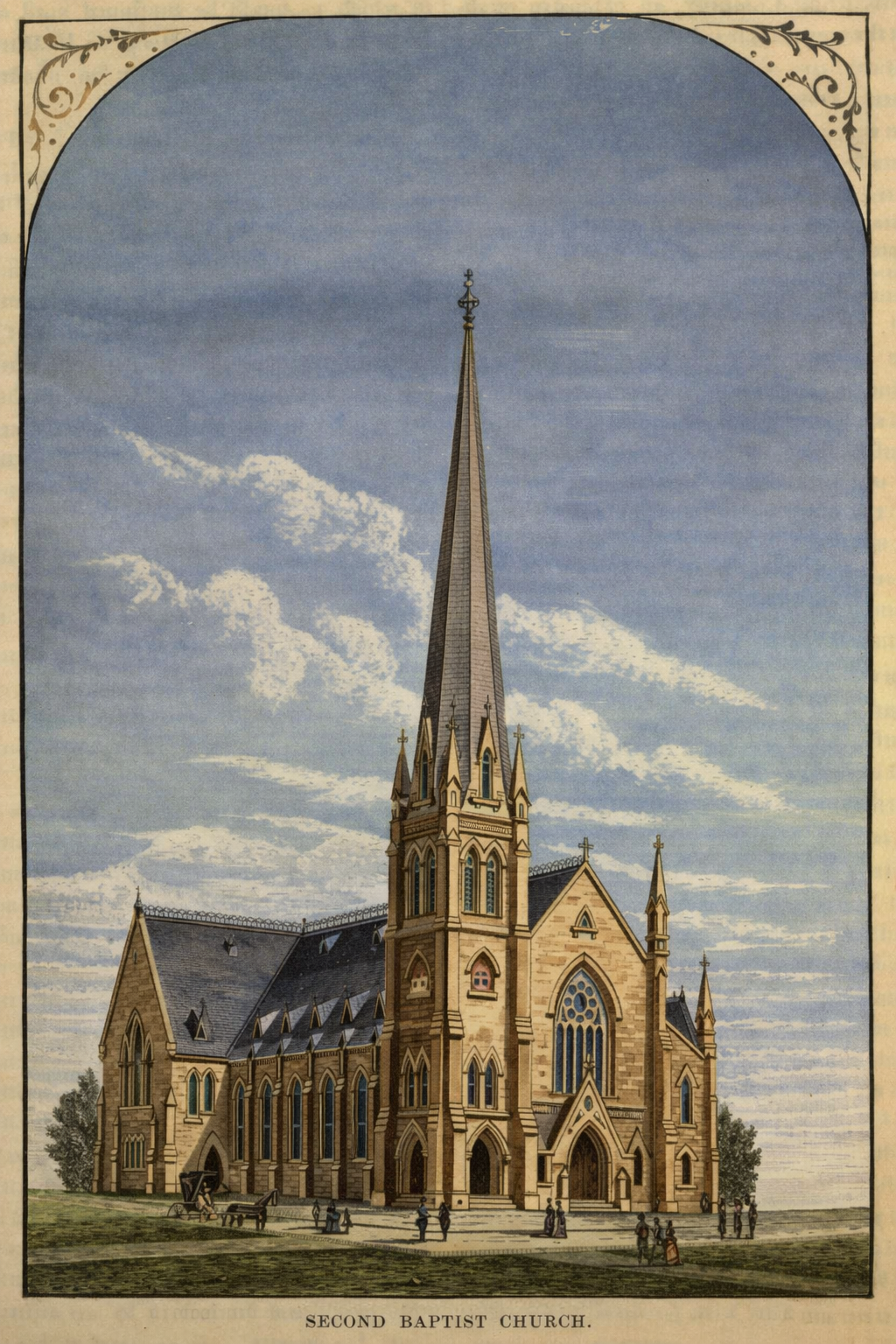
The Second Baptist Church stood in 1875 as one of the great institutional landmarks of westward-expanding St. Louis. Located at Beaumont and Locust Streets on Plate 71 of Compton and Dry’s Pictorial St. Louis, the massive Gothic structure symbolized not only the growth of a congregation, but the confidence, ambition, and civic energy of an entire city entering its post–Civil War peak.
The history of the church reached back to the earliest Protestant missionary efforts in frontier St. Louis. In 1817, Baptist missionaries Rev. John M. Peck and Rev. James E. Welch arrived in the small Mississippi River village to begin religious work among its scattered settlers. Their efforts resulted in the formation of the First Baptist Church in 1818, though that congregation later declined and disappeared. In 1833, a new congregation of thirteen members was formally organized under the enduring name Second Baptist Church of St. Louis. Supported initially by the American Baptist Home Mission Society, the church quickly became one of the city’s leading Baptist institutions.
During its early decades, the congregation moved through several locations while steadily growing alongside the city itself. By the 1840s the church had become a major force within the expanding Protestant community of St. Louis. Under influential pastors including Rev. I. T. Hinton, Rev. J. B. Jeter, and Rev. Galusha Anderson, the congregation increased dramatically in membership and influence. Hundreds were added through baptism and transfer, and the church became deeply involved in missionary and church extension efforts throughout the city.
The congregation also played a central role in the creation of other Baptist institutions in St. Louis. German Baptist, Third Baptist, Fourth Baptist, and ultimately the Beaumont Street Baptist Church all emerged directly from Second Baptist membership and missionary activity. In this sense, Second Baptist functioned as a “parent congregation” whose influence spread westward with the city’s growing population.
Like many St. Louis institutions, the church endured significant challenges during the turbulent mid-nineteenth century. Financial hardship following the Panic and Great Fire of 1849 threatened the congregation, yet the church survived and continued its expansion. During the Civil War years, church leadership openly supported the Union cause, reflecting the strong Unionist sentiment found among many of the civic and professional classes occupying the Lucas and Garrison district.
By the early 1870s the congregation sought a new home worthy of its stature and growing membership. In 1872 an eligible lot at the northwest corner of Beaumont and Locust Streets was purchased for approximately $30,000. Construction soon began on a magnificent new sanctuary designed in the English Gothic style. The church was nearing completion when Compton and Dry prepared Plate 71, and the building was formally dedicated in January 1875 — making it one of the newest and most ambitious structures represented in the atlas.
The completed church was monumental in scale and richly detailed in design. Built of St. Louis limestone with Missouri gray sandstone trim, the structure featured a soaring 200-foot spire visible across much of the surrounding district. The vast sanctuary included galleries, lecture halls, reading rooms, robing rooms, reception parlors, Sunday school facilities, an infant room, and a large baptistry. More than simply a house of worship, the building functioned as a major educational, social, and civic center for the neighborhood.
The congregation’s leadership reflected the interconnected institutional networks that characterized late nineteenth-century St. Louis. Men associated with the church participated in business, education, philanthropy, and urban development throughout the city. The church itself became both a symbol and a product of the civic-minded culture that fueled St. Louis’s remarkable growth during the era.
The inclusion of Second Baptist Church in Pictorial St. Louis demonstrates the importance contemporaries attached to the institution. Like nearby Central Presbyterian Church, which was also still under construction when represented on Plate 71, the Second Baptist illustration reflected not merely the city as it existed, but the city St. Louis believed itself to be becoming — prosperous, sophisticated, confident, and expanding westward with extraordinary ambition.
Today the story of Second Baptist Church provides an important window into the broader social and institutional fabric of the Lucas and Garrison neighborhood. The church was not an isolated religious structure, but part of a dense network of congregations, schools, businesses, charitable organizations, and civic leaders whose collective efforts shaped the identity and progress of nineteenth-century St. Louis.

 Second Baptist Church