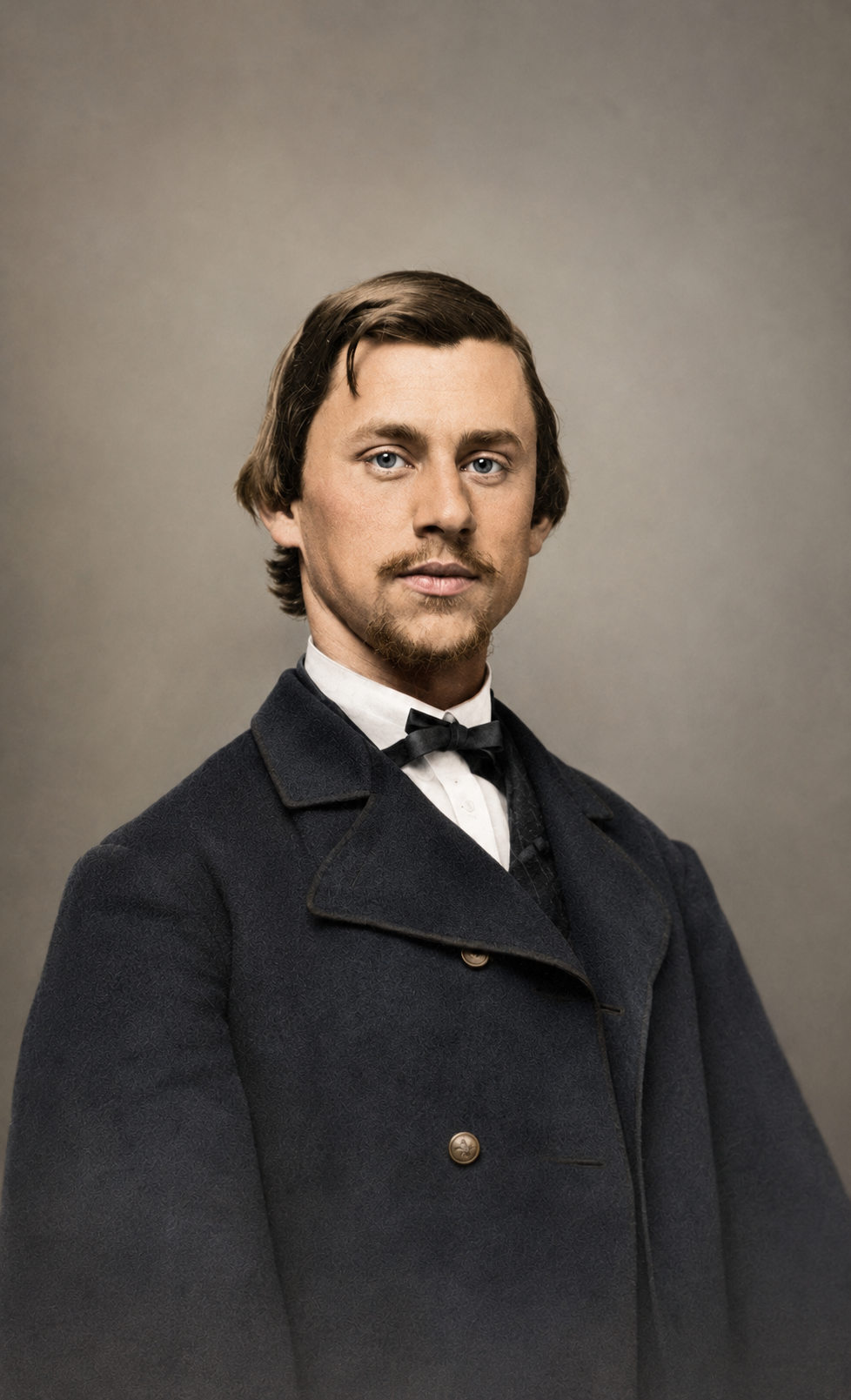
Andrew J. Fox
2828 Olive Street
Photographer
Daguerreotypists
205 N. 5th Street

Born: August, 1828
New York, USA
Died: April 23, 1919 (aged 90)
St. Louis, Missouri
Buried: Bellfontaine, Cemetery
St. Louis, Missouri

Spouse: Harriet Ann Swett Fox
Born: April 4, 1833
Haverhill, Essex County, Massachusetts, USA
Died: November 12,1899 (aged 66)
St. Louis County, Missouri, USA
Buried: Bellfontaine Cemetery
St. Louis, Missouri

Andrew Jackson Fox belonged to one of the city’s most visually important professions: the men who helped St. Louis see itself. Listed in Gould’s 1875 Directory as a photographer and daguerreotypist at 205 North Fifth Street, while living at 2828 Olive Street, Fox represents the transition from early photographic novelty to established urban profession.

Born in New York in August 1828, Fox married Harriet Ann Swett in Jacksonville, Illinois, on July 22, 1851. By the following year, the young couple had settled in St. Louis, where Fox entered the emerging trade of photographic portraiture. One later photographers’ reference lists him as a St. Louis daguerreian beginning in 1852, with early studios on or near North Fourth Street, then one of the city’s important commercial corridors. (Craig Camera)

Fox’s career placed him among the city’s early photographic craftsmen, alongside better-known names such as Thomas Easterly. The daguerreotype, ambrotype, carte-de-visite, and later studio portrait were not merely personal keepsakes; they were tools of identity, memory, respectability, and social presence. In a city growing as rapidly as St. Louis, the photographic studio became a democratic parlor of permanence. Merchants, clergy, soldiers, widows, children, and civic leaders could sit before the camera and leave behind an image that paper records alone could never preserve.

Fox appears to have been both persistent and adaptable. One modern account describes A. J. Fox as “one of the earliest and most prolific photographers in St. Louis,” active from 1852 until sometime after 1887, with studios generally located in the prestigious downtown studio district near North Fourth Street. (Uncommon Ancestors) By 1875, his address at 205 North Fifth Street placed him in the commercial heart of the city, while his home at 2828 Olive Street placed him within the Lucas and Garrison neighborhood at a time when that area housed businessmen, clergy, physicians, manufacturers, and professionals whose lives connected directly to the city’s expansion.

The Fox household also became a photographic family enterprise. Andrew and Harriet were the parents of Charles A. Fox, Frank Fox, William Henry Fox, Wimar F. Fox, Lillian G. Fox, and Della May Fox, and family references indicate that Fox and his sons maintained photography studios in St. Louis for many years. In that sense, Fox was not simply an individual photographer; he was part of a multi-generational visual trade.

Harriet Ann Swett Fox died in 1899. Andrew Jackson Fox lived until April 23, 1919, reaching the age of ninety. Both are buried at Bellefontaine Cemetery, where so many of the city’s nineteenth-century builders, record-keepers, and witnesses rest.

LucGar Connection

Fox’s importance to the project is not that he built bridges, ran banks, refined sugar, or led a church. His contribution was quieter but profound: he helped preserve the faces of the generation that did those things.

In a neighborhood study built from directories, maps, census schedules, cemetery records, and scattered newspaper fragments, Andrew J. Fox reminds us that memory itself was an industry. The camera was becoming one of the instruments by which a rising city documented its own people. For Lucas and Garrison, Fox offers a perfect doorway into a future rabbit trail: “Early Photography in St. Louis.”