
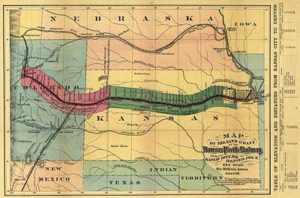
Route of the Kansas Pacific Railroad
The Kansas and Pacific Railroad: Western Expansion and the Reach of St. Louis Capital
In the years immediately following the Civil War, few enterprises captured the ambition and scale of American expansion more vividly than the Kansas Pacific Railroad. Stretching westward across the plains from Kansas City toward Denver, it formed a critical segment of the nation’s emerging transcontinental rail network—linking eastern industry with the vast, undeveloped interior of the continent.
For St. Louis, a city striving to assert itself as the commercial gateway to the West, the Kansas Pacific represented both opportunity and competition. And for men like Robert E. Carr and Stephen M. Edgell, it offered a direct pathway into one of the most transformative economic movements of the nineteenth century.
A Railroad Born of National Ambition
The Kansas Pacific originated as the eastern division of the Union Pacific Railroad, authorized under the Pacific Railway Act of 1862. Its purpose was straightforward in concept yet immense in execution: to push rail lines westward across the plains, linking the Mississippi Valley with the Rocky Mountains and beyond.
By the late 1860s, the line had advanced across Kansas, reaching Denver by way of the Denver Pacific connection in 1870—a project directly associated with Robert E. Carr. This linkage transformed Denver from a remote frontier settlement into a connected commercial center almost overnight.
Railroads did not merely follow settlement—they created it.
Robert E. Carr and the Western Push
Few figures embody this expansion more clearly than Robert E. Carr, resident of 3130 Lucas Avenue on Plate 71. By 1871, Carr had risen to the presidency of the Kansas Pacific Railroad, placing him at the center of western rail development at a decisive moment.
Carr’s role extended beyond administration. He was instrumental in:
-
Directing the construction of the Denver Pacific Railroad
-
Linking Colorado’s mineral wealth to national markets
-
Advancing the integration of western territories into the broader economy
The naming of Carr, Colorado, and the later development of Carrswold in St. Louis serve as quiet reminders of how deeply his influence extended—geographically and economically.
From a residence on Lucas Avenue, Carr’s reach extended across hundreds of miles of track into the developing American West.
Stephen M. Edgell and the Supporting Network
While Carr represents the executive leadership of the Kansas Pacific, figures such as Stephen M. Edgell illustrate the broader network of professionals, investors, and operators necessary to sustain such enterprises.
Railroads in this era were not singular achievements but complex systems of coordination, requiring:
-
Engineers and surveyors
-
Financiers and brokers
-
Legal and administrative oversight
-
Local representatives in key cities like St. Louis
Edgell’s connection to the Kansas Pacific places him within this essential framework—part of the machinery that translated vision into iron, timber, and motion.
St. Louis: Gateway or Bypassed City?
For St. Louis, the rise of western railroads carried a dual implication.
On one hand, the city remained a major supplier of:
-
Manufactured goods
-
Banking and investment capital
-
Skilled labor and technical expertise
On the other, the routing of transcontinental lines north through Chicago threatened to diminish St. Louis’s long-held dominance as the primary gateway to the West.
The Kansas Pacific thus represents a moment of uncertain transition:
A future being built in which St. Louis was both indispensable and increasingly challenged.
The Railroad as a Force of Transformation
The impact of the Kansas Pacific extended far beyond transportation. It reshaped the physical and economic landscape of the nation:
-
Towns emerged along its route
-
Mining and agriculture expanded rapidly
-
Migration accelerated into previously inaccessible regions