
St. Louis Telegraph Pioneers

The Telegraph as a Portal: A LucGar Rabbit Trail

To understand Isaac M. Veitch is to step into a much larger story—one that extends far beyond a single household on Garrison Avenue.

The telegraph industry in St. Louis was not merely a technological novelty; it was a critical artery in the city’s rise. By the mid-19th century, companies such as Western Union Telegraph Company had begun consolidating regional lines into a national network, transforming communication into a centralized, commercial enterprise. St. Louis, positioned between eastern capital and western opportunity, became a vital hub in this system.

https://images.openai.com/static-rsc-4/IMkCU8bHFjGr-TaMZ6HZ7OX0KwhmXT6kFyFTB2pS4ZbKa-RTWdcF4DwY2-krozx-ihaVlIM6g5BFKtJkpQ1oedZ4f15OfcmXU7Qxlc61EF05Lk9yIWk0RYE79XW2qhHus-1jh03ZW17YgxJtj-WYSCOUm-f-hUqdCrXsKUsOoz8n_0DWICaT798NAaolTcm4?purpose=fullsize

Telegraph offices became fixtures of urban life—part business center, part information exchange. Inside, operators translated bursts of electrical signals into written words, often working at remarkable speed and precision. The atmosphere was one of urgency and quiet intensity, where fortunes could hinge on the accurate transmission of a single message.
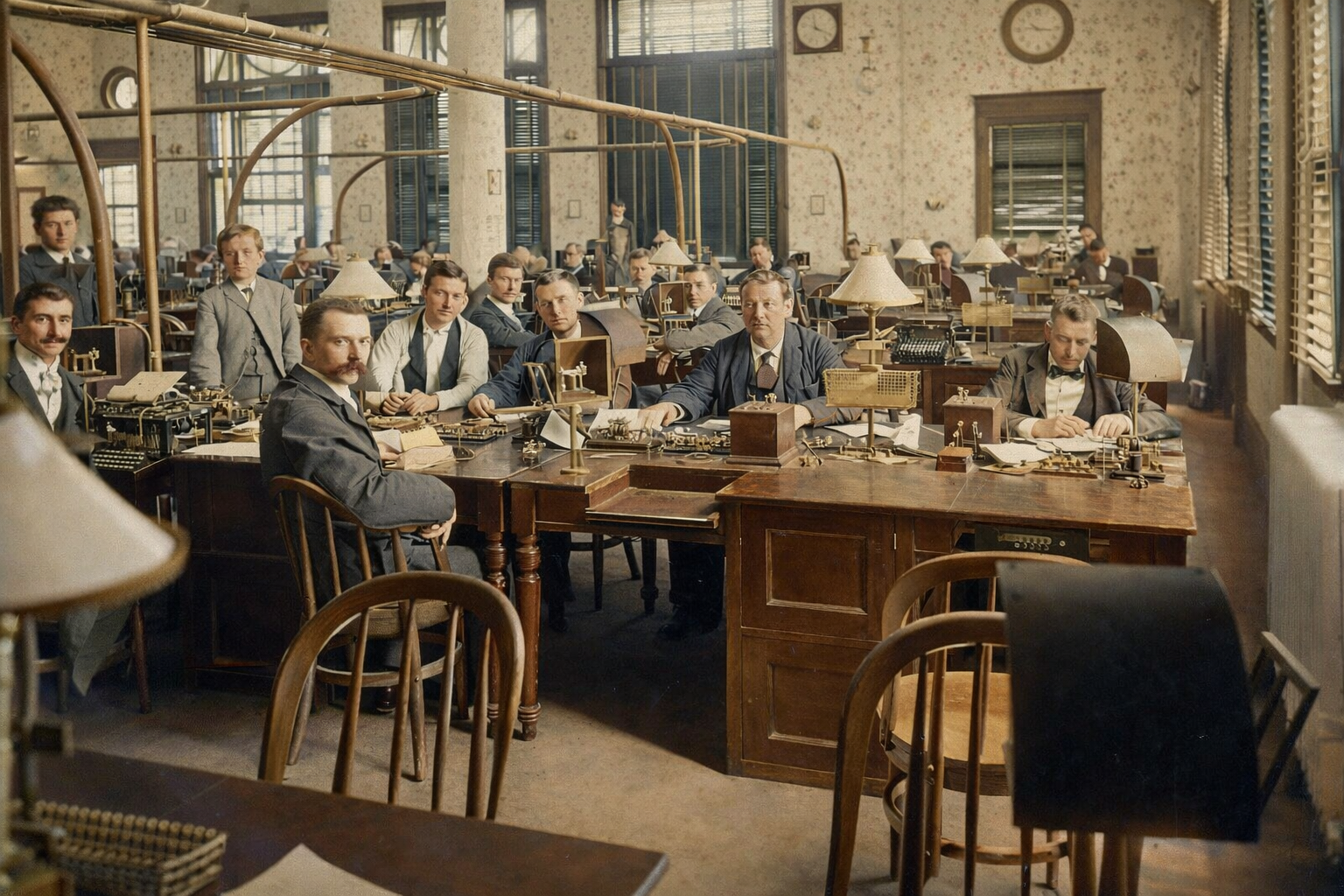
Early Telegraph Office

For St. Louis, the implications were profound:

  • Commercial Acceleration: Grain prices, commodity markets, and river traffic could be monitored in near real time.

  • Railroad Coordination: Telegraph lines ran alongside tracks, allowing dispatchers to manage increasingly complex rail systems.

  • News Dissemination: The city’s newspapers became part of a national information network, receiving dispatches from across the country.

  • Civic Integration: Government, business, and transportation systems became interconnected in ways previously unimaginable.

It is within this dynamic environment that Isaac M. Veitch operated. Whether as an organizer, administrator, or technical participant, his role tied him directly to the infrastructure that enabled St. Louis to function as a modern city.


Interpretive Significance within Lucas & Garrison

Isaac M. Veitch represents a distinct and essential category within the Plate 71 residents: the connectors. While others accumulated wealth or wielded influence, Veitch helped construct the invisible systems that allowed that influence to operate efficiently.

His presence in the neighborhood reinforces a broader truth about the Lucas and Garrison district in 1875—it was not merely a collection of affluent households, but a concentration of individuals deeply embedded in the mechanisms of a rapidly modernizing city.

Through Veitch, the neighborhood becomes linked not just to local history, but to the national story of technological transformation.


Closing Reflection

In many ways, Isaac M. Veitch’s legacy is best understood not through what survives of his personal biography, but through what flowed through the wires he helped sustain. Every transmitted message, every coordinated train, every reported event carried forward the quiet work of men like Veitch.

And in that sense, his story is not an isolated thread—but part of the vast, humming network that defined a new era.