
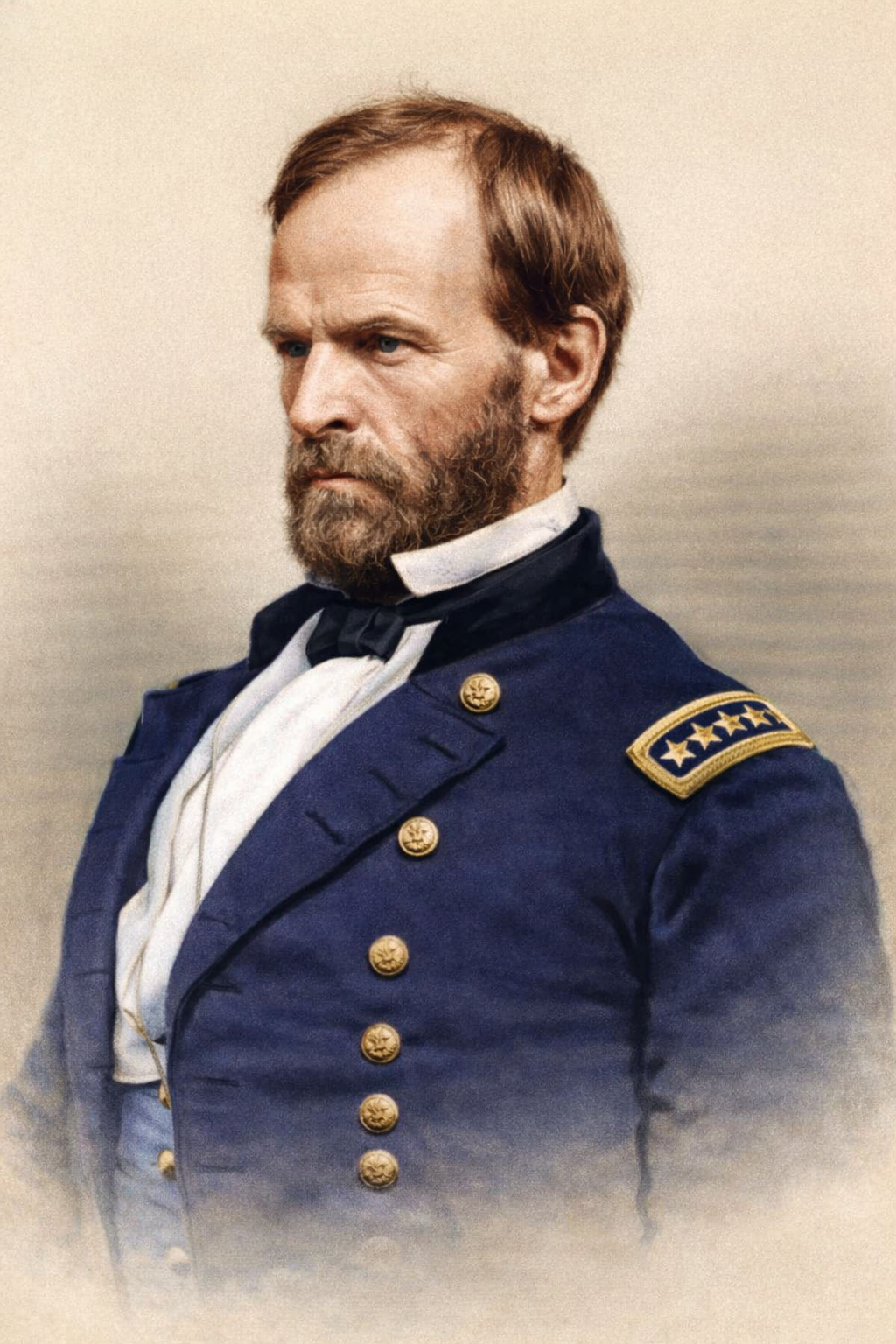
General William Tecumseh Sherman
General William Tecumseh Sherman
912 Garrison Avenue
Commanding General of the U.S. Army - 1869-1883
Born: February 8, 1820
Lancaster, Ohio
Died: February 14, 1891 of pneumonia
New York City, New York
Buried: Calvary Cemetery
St. Louis, Missouri
Spouse: Eleanor Boyle Ewing (married 1850, died 1888)
General Sherman lived at 912 Garrison, his home technically north of Plate 71 on Plate 72. A corner of his property appears on Plate 71 so, due to his significance to the neighborhood, we are including him in these profiles.
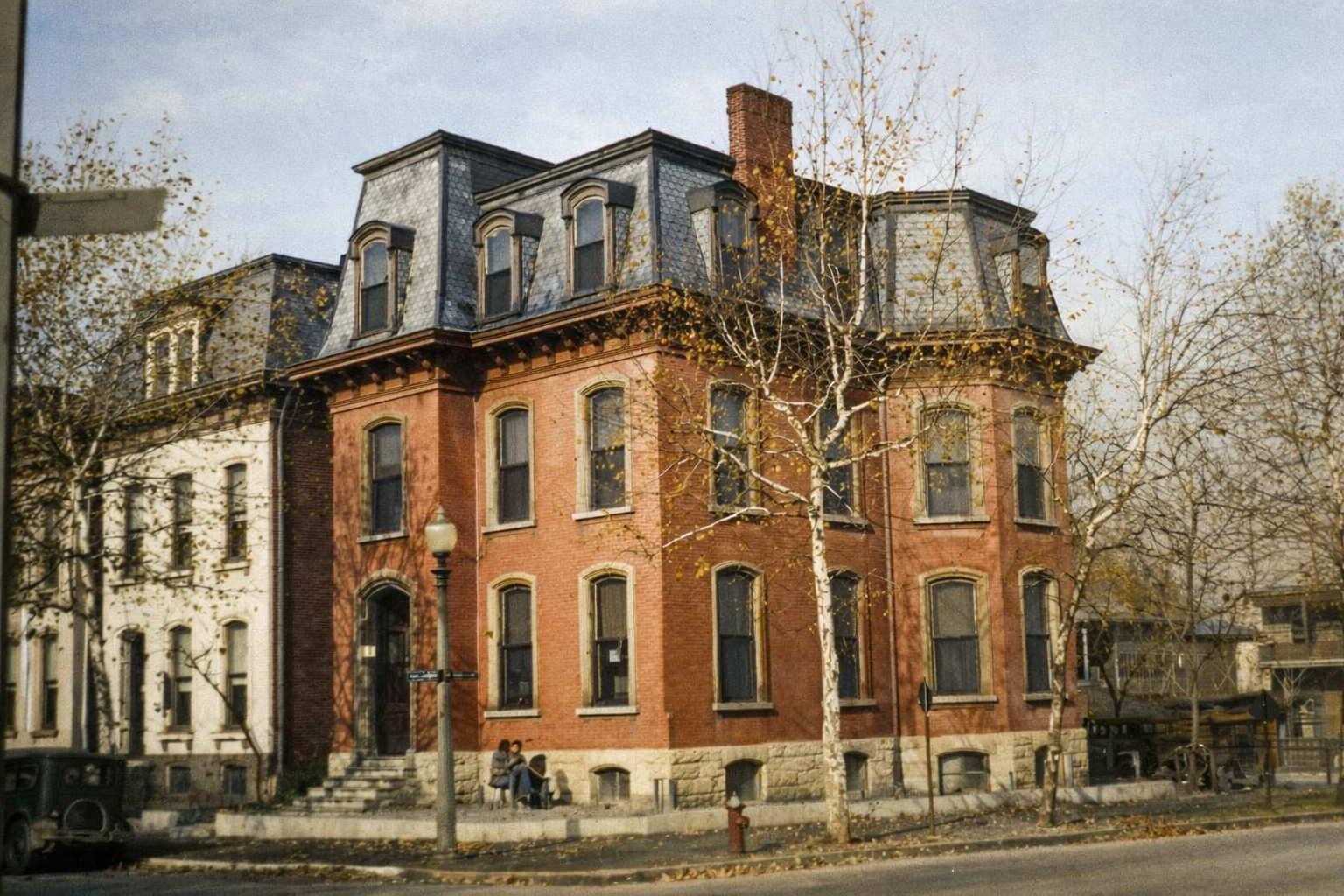
912 Garrison Avenue
Commanding General Sherman lived at 912 Garrison Avenue in 1875, one block north of Plate 71. This was his St. Louis home.
William Tecumseh Sherman was born on February 8, 1820 and was an American soldier, businessman, educator, and author. He served as a general in the Union Army during the American Civil War from 1861–1865, achieving recognition for his command of military strategy as well as criticism for the harshness of the scorched-earth policies that he implemented against the Confederate States.
British military theorist and historian B. H. Liddell Hart declared that Sherman was "the most original genius of the American Civil War" and "the first modern general”.
In the 1860s, Sherman moved to St. Louis to become president of a streetcar company called the "Fifth Street Railroad.” Thus, he was living in the border state of Missouri as the secession crisis reached its climax. While trying to hold himself aloof from politics, he observed first-hand the efforts of aforementioned Congressman Frank Blair, who later served under Sherman in the U.S. Army, to keep Missouri in the Union. In early April, Sherman declined Frank Blair’s brother, Montgomery Blair's offer of the administrative position of chief clerk in the War Department, despite Blair's promise that it would be followed by nomination as Assistant Secretary of War after the U.S. Congress assembled in July.
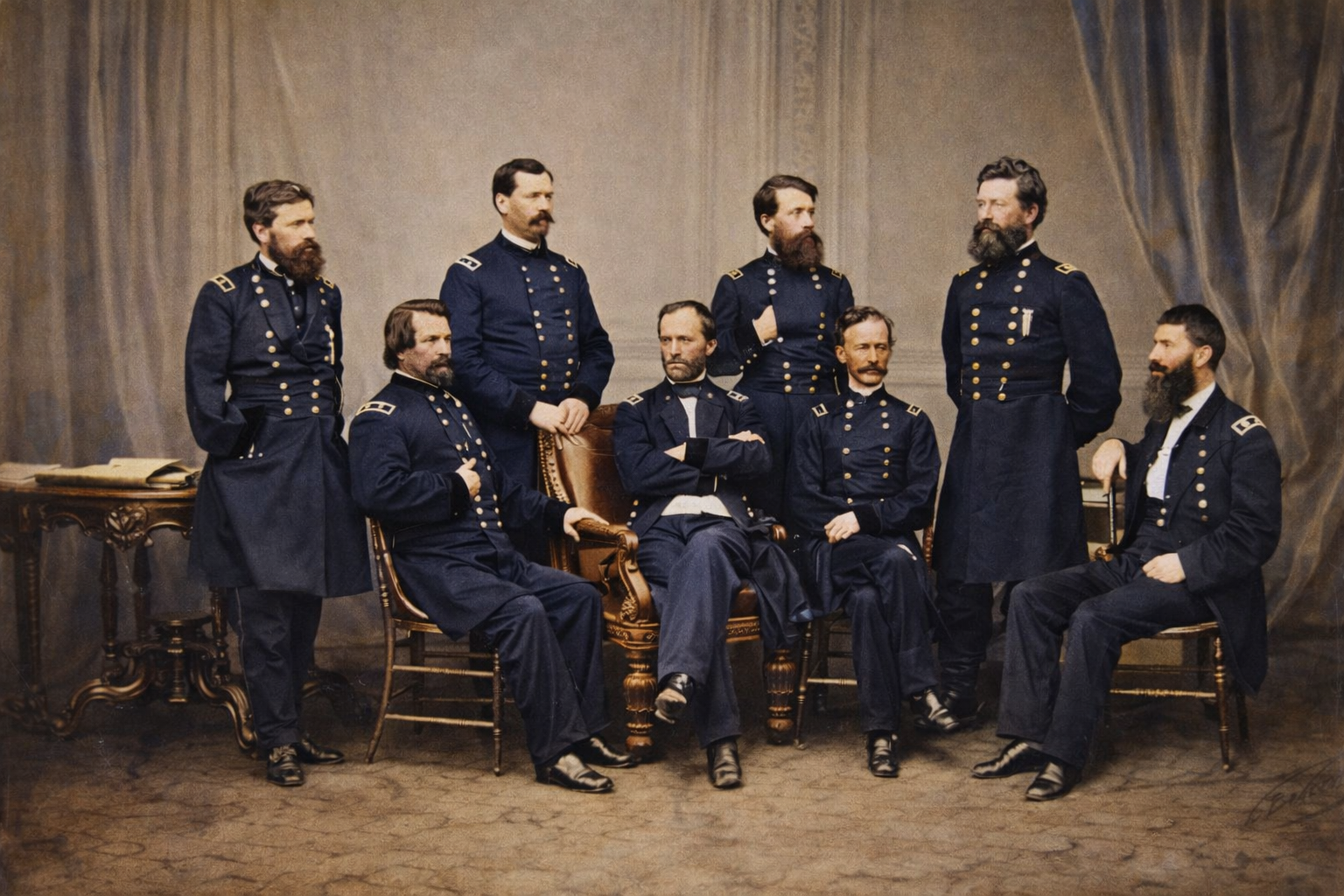
General Sherman and his Civil War Staff
General Sherman’s Civil War credentials are vast and exemplary and many think it was his successes that led to the ultimate victory of the Union Army.
The War Ends — A Reluctant National Figure (1865–1869)
When the guns fell silent in 1865, General William Tecumseh Sherman stood among the most recognizable men in America. His “March to the Sea” had secured his place in history, but peace did not bring him rest—it brought expectation.
Sherman emerged from the war both celebrated and controversial. To many in the North, he was the embodiment of decisive victory. To much of the South, he represented devastation. Yet Sherman himself resisted both glorification and political elevation. Unlike so many of his contemporaries, he had no desire to convert military fame into political power.
When approached about a potential presidential run, Sherman issued one of the most famous refusals in American history:
“I will not accept if nominated, and will not serve if elected.”
This was not modesty—it was conviction. Sherman believed deeply in the separation of military service and political leadership, a principle that would guide the remainder of his life.
When Grant became President of the United States in March 1869, Sherman succeeded him as Commanding General of the Army. Sherman served in that capacity from 1869 until 1883 and was responsible for the U.S. Army's engagement in the Indian Wars.
Sherman's early tenure as Commanding General was marred by political difficulties, many of which stemmed from disagreements with Secretary of War John Rawlins and his successor, William W. Belknap, both of whom Sherman felt had assumed too much power over the army and reduced the position of Commanding General to a sinecure. Sherman also clashed with Eastern humanitarians who were critical of the army's harsh treatment of the Indians and who had apparently found an ally in President Grant. To escape from these difficulties, Sherman moved his headquarters to St. Louis in 1874.
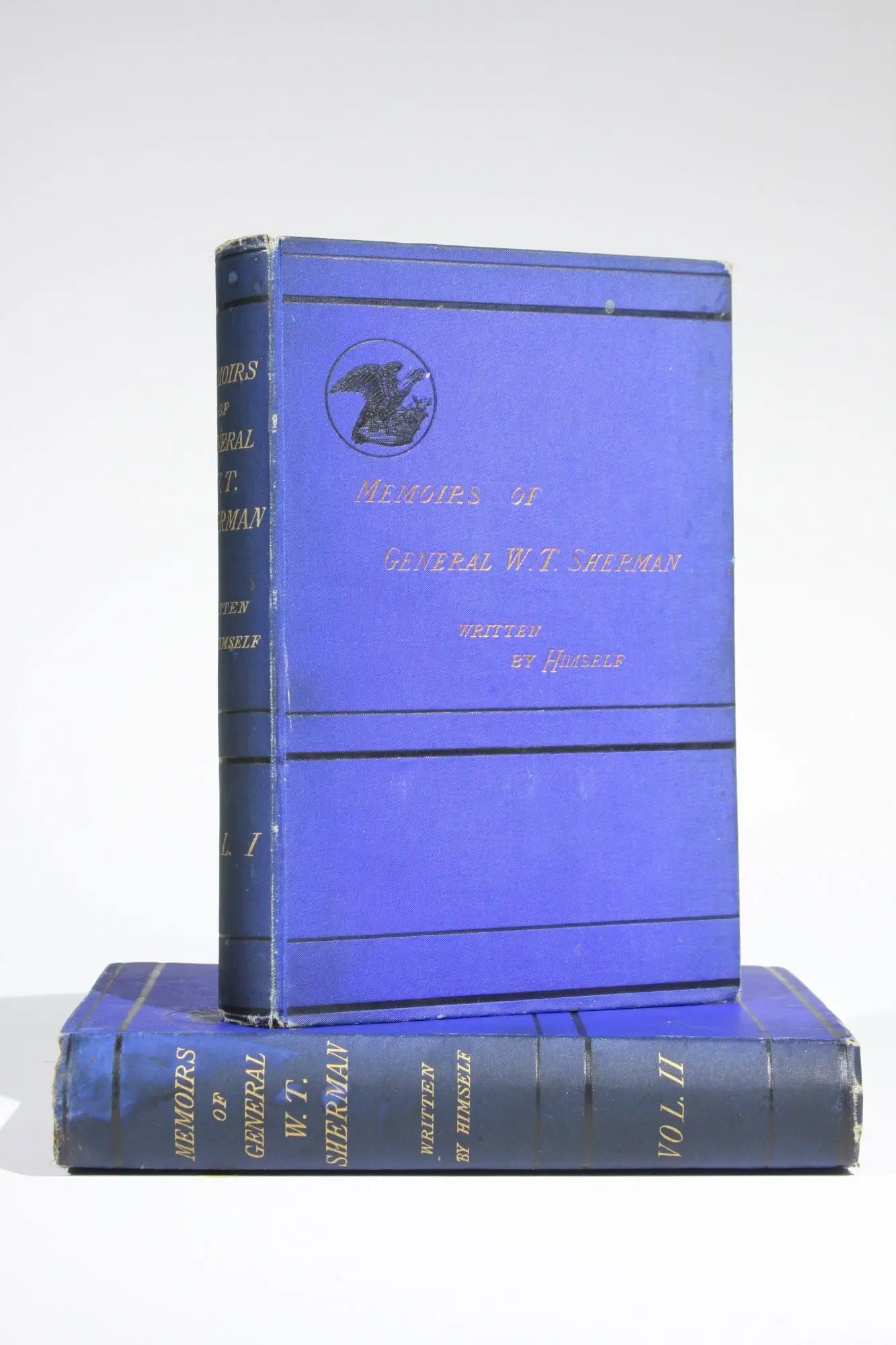
The Memoirs of General William T. Sherman. By Himself.
In 1875, ten years after the end of the Civil War, Sherman became one of the first Civil War generals to publish his memoirs. The Memoirs of General William T. Sherman. By Himself. Published by D. Appleton & Company in two volumes, the work began with the year 1846 (when the Mexican War began) and ended with a chapter about the "military lessons of the Civil War.”
According to critic Edmund Wilson, Sherman:
Sherman had a trained gift of self-expression and was, as Mark Twain said, “a master of narrative. In his Memoirs the vigorous account of his pre-war activities and the conduct of his military operations is varied in just the right proportion and to just the right degree of vivacity with anecdotes and personal experiences. We live through his campaigns ... in the company of Sherman himself. He tells us what he thought and what he felt, and he never strikes any attitudes or pretends to feel anything he does not feel.”
Sherman died of pneumonia in New York City on February 14, 1891, six days after his 71st birthday. President Benjamin Harrison, who served under Sherman in the Civil War, sent a telegram to Sherman's family and ordered all national flags to be flown at half staff. Harrison, in a message to the Senate and the House of Representatives, wrote:
“He was an ideal soldier, and shared to the fullest the esprit de corps of the army, but he cherished the civil institutions organized under the Constitution, and was only a soldier that these might be perpetuated in undiminished usefulness and honor.”
On February 19, a funeral service was held at his home in New York City, followed by a military procession.
Joseph E. Johnston, the 84 year old Confederate General of the Army of Tennessee, who was considered one of the most feared Confederate generals, served as a pallbearer. He had commanded the fierce resistance to Sherman's troops in Georgia and the Carolinas. It was a bitterly cold day and a friend of Johnston, worrying that the general might become ill, asked him to put on his hat. General Johnston replied: "If I were in Sherman's place, and he were standing in mine, he would not put on his hat." Johnston did catch a serious cold and died one month later of pneumonia.
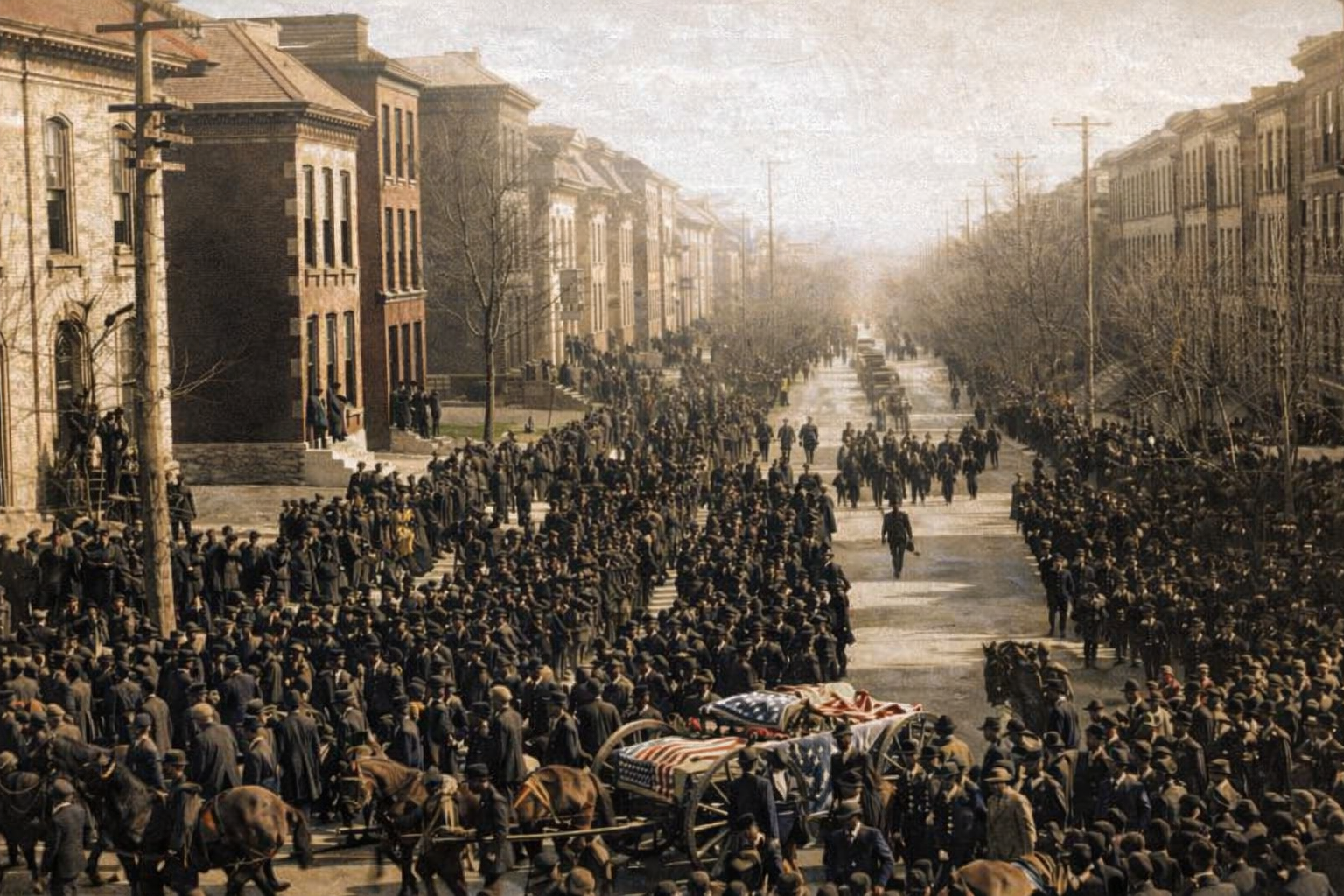
General Sherman's St. Louis Funeral Procession
Sherman's body was transported to St. Louis, where another service was held. His son, Thomas Ewing Sherman, who was a Jesuit priest, presided over his father's funeral masses in New York City and in St. Louis. Thus began the funeral procession of Gen. William Tecumseh Sherman. For four hours on Feb. 21, 1891, a procession of 12,000 soldiers, veterans and notables marched past countless mourners on a winding, seven-mile path from downtown to Calvary Cemetery.
William and Ellen Sherman had returned to St. Louis at war's end. Grateful businessmen raised $30,000 to buy and furnish their spacious two-story home at 912 North Garrison Avenue. They lived there on and off for 11 of their remaining years.
Former U.S. president and Civil War veteran Rutherford B. Hayes, who attended both funeral ceremonies, said at the time that Sherman had been "the most interesting and original character in the world."
Sherman is buried alongside his wife in Calvary Cemetery in St. Louis
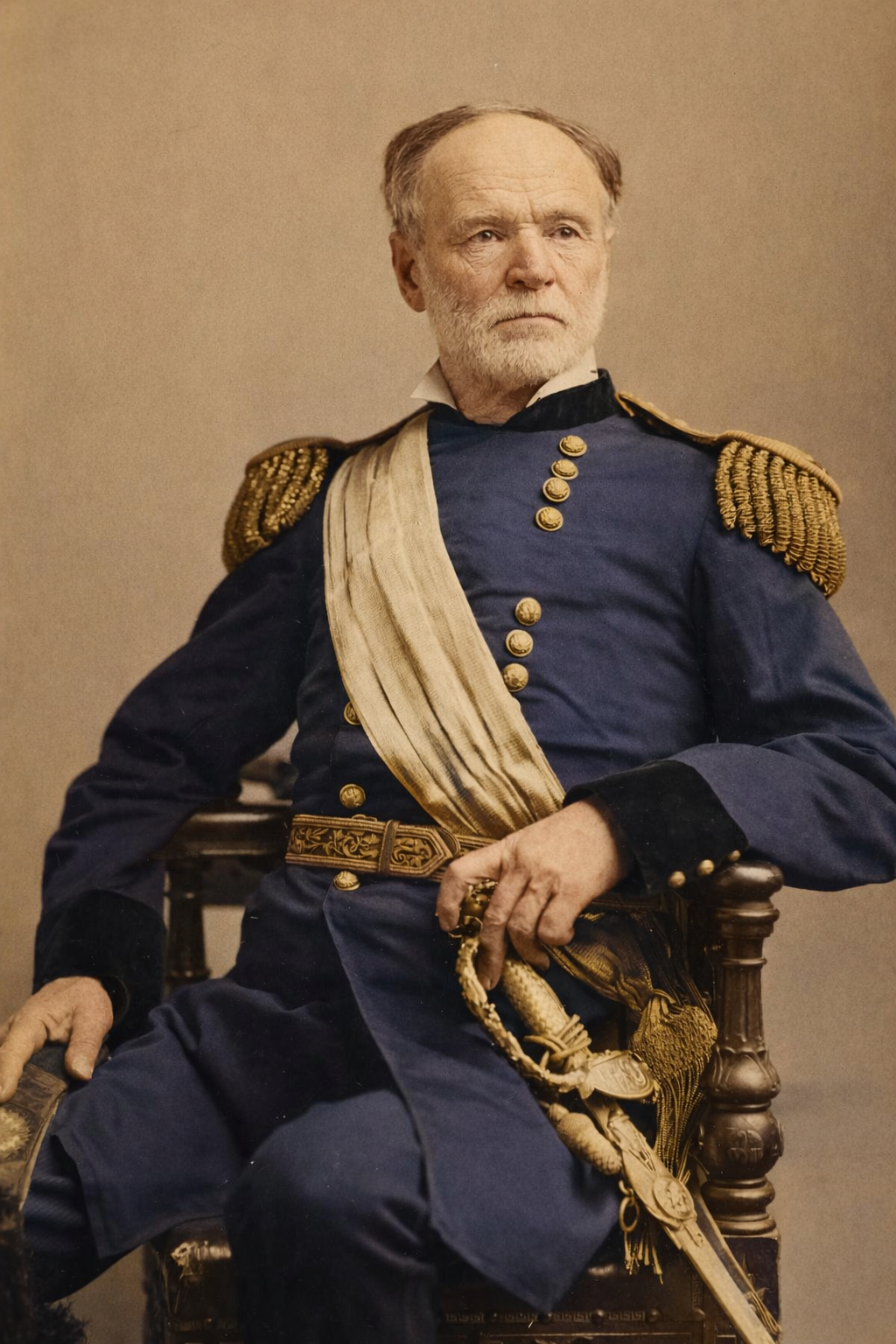
General Sherman - Post Civil War
Reflective Addendum — The Sherman Paradox
Sherman’s postwar life presents a paradox that fits squarely within the Lucas and Garrison guiding philosophy:
He was a man who hated war, yet perfected its most devastating applications.
He rejected political power, yet shaped national policy from a military post.
He lived quietly in St. Louis, yet directed campaigns that reshaped an entire continent.
Within a single block of this study area lived a man whose decisions influenced:
-
The fate of the American West
-
The expansion of railroads and industry
-
The lives of countless Native American communities
-
The memory and meaning of the Civil War
And yet, in the daily rhythm of the neighborhood, he would have appeared simply as another distinguished resident—one among many remarkable lives intersecting in this small geographic space.