
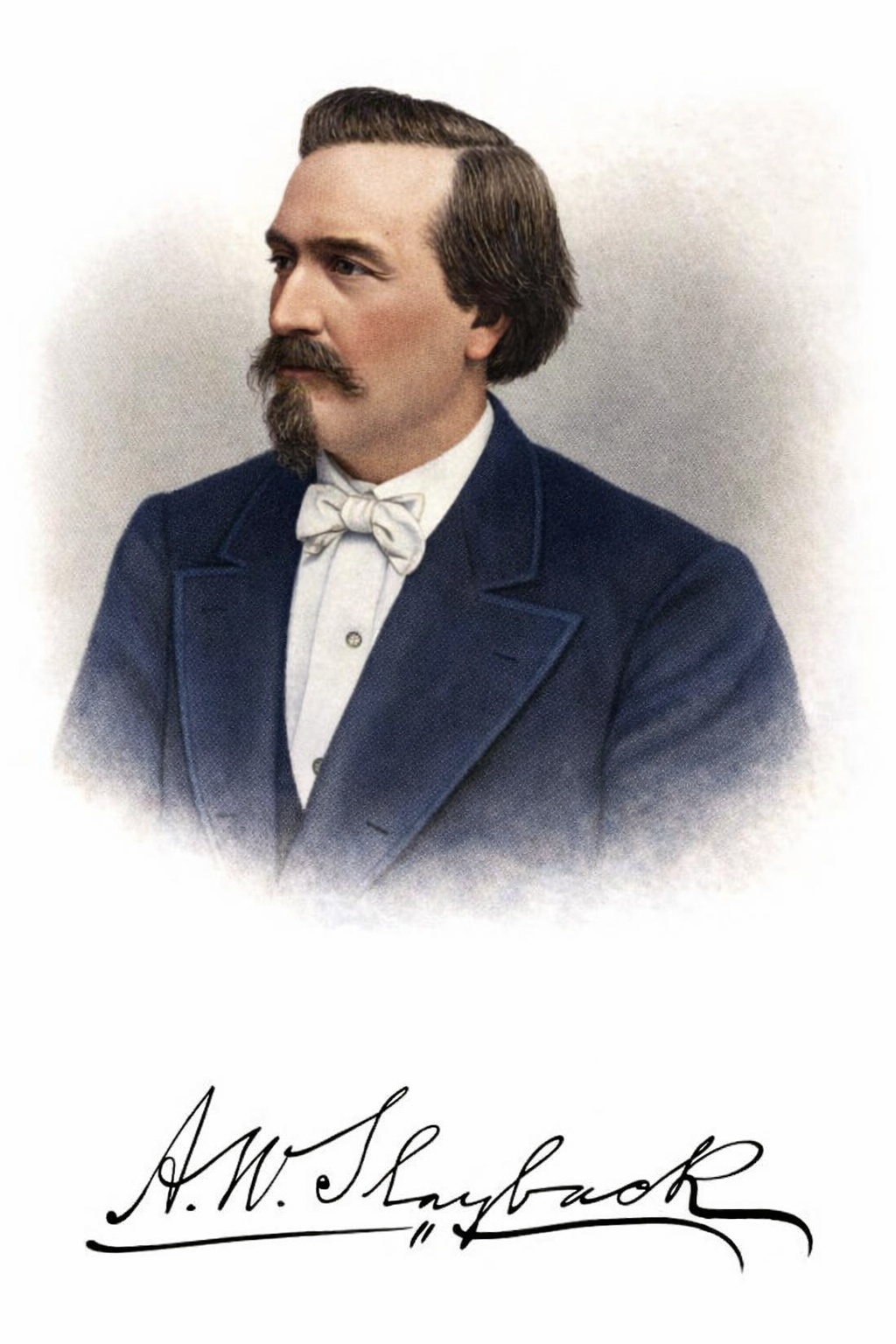
Colonel Alonzo W. Slayback
Colonel Alonzo William Slayback
2787 Olive Street
Born: July 4, 1838
Marion County, Missouri
Died October 13, 1882 (44 years old)
St. Louis, Missouri
Buried: Belfountaine Cemetery
St. Louis, Missouri
Spouse: Alice Waddel
Conspicuous among the men who, by their talents and accomplishments, grace a Bar long renowned for its intellectual gifts, is the subject of the present sketch. Colonel Alonzo William Slayback. He was born on July 4, 1838, at Plum Grove, Marion County, Missouri, the homestead of his maternal grandfather, J.A. Minter. His father, Alexander L. Slayback, was a lawyer of eminent ability, and his mother a woman of great strength of character, adorned with all the virtue and graces of the highest order of cultured, Christian womanhood. His grandfather was Dr. Abel Slayback, of Cincinnati, one of the most distinguished physicians of hiss day. His great grandfather was Solomon Slayback, a soldier of the Revolutionary War, and under General Washington’s command at Valley Forge, and a faithful upright man.
The early education of young Alonzo was conducted almost entirely by his mother, and to her teachings and example he is doubtless indebted for much of the sterling spirit of self-reliant independence that high sense of honor which have so strongly characterized his career. At ten years of age, having completed his preparatory studies, he was sent to the Masonic College at Lexington, where, after a course of eight years sin the different branches of a collegiate education, he graduated in 1856, carrying off the first honors in a class of seven. His ambition from boyhood having been to become a lawyer, his studies, during the last four years of his college life, were directed mainly to that end. At the termination of his course, he taught school and studied law alternately - an experience which is noticeable in the early struggles of many of the most noted lawyers of the West. In September 1857, he was admitted to practice at St. Joseph, Missouri where he successfully followed his profession until 1861.
The great Civil War was upon the land. Born and reared on Southern soil, surrounded from childhood with Southern institutions, and imbued with a deep, impassioned love for his native section, he promptly decided upon the course he should pursue. Espousing the cause of State Rights as interpreted by the Governor, Claiborne F. Jackson, he raised a regiment of cavalry, was elected its Colonel, and joined the command of General Price at Lexington, in June 1861. At the expiration of their term of service, he enlisted in the Confederate army, and had partially recruited another regiment, when the transfer of General Price’s troops to Tennessee temporarily put an end to these operations in the West. At the battle of Elkhorn, however, he was assigned the command of a regiment hastily gotten up for the occasion, partly of State and partly of Confederate troops, and they did splendid service. Soon afterward transferred to the east side of the Mississippi, he was promoted for meritorious conduct at Corinth and Farmington. Acting under orders of the Secretary of War, Colonel Slayback re-crossed the Mississippi, and reported to General Hindman, who assigned him to duty with the cavalry at the front. After many months’ patient effort, and many stirring adventures, he succeeded in raising another regiment of cavalry, which was attached to Shelby’s old brigade, and in this command he served until the close of the war.
Few men of his age left the battle-scarred ranks of the fallen Confederacy with a brighter record for bravery and promptness upon the field. His comrades on many a hard-fought plain, in many a fiery fray, gray, grisly, war-worn veterans, all unite in declaring that no man was oftener found in the battle’s red front, where the shot flew thickest and the struggle was fiercest, than Colonel Slayback. During his term of service, he took part in more than forty battles and skirmishes, and only sheathed his sword when he saw that hope was at an end. At the close of the eventful struggle, feeling that all he had loved and fought for was lost, he resolved to seek a home in some foreign land. With forty-eight of his old regiment, who elected him as their captain, he joined Shelby’s expedition to Mexico, and for a year wandered up and down in that distracted country, sharing the vicissitudes, misfortunes and romantic adventures of that resolute band, in search of employment fit for soldiers.
But his mother still lived, and with a mother’s love yearned for her gallant boy. With a heroism that could only come of mother-love, she resolved to seek him amid the wild, war-rent land of the Montezumas. After a long and perilous journey to Mexico, she found him, and persuaded him, though not without difficulty, to return to his native soil. He came back from Mexico in 1866 and settled in St. Louis, where he has ever since practiced his profession, with constantly-increasing distinction.
His success in the race for forensic honors has been most remarkable. Ten years ago a comparative stranger, with the strange air of the camp and of foreign lands upon him, he to-day stands peerless among the jury lawyers of Missouri, and his name is a household word throughout the State. The records of the various courts show that, as a jury advocate, he has gained a larger and lost a smaller proportion of cases than any other active practitioner at the St. Louis Bar. His practice is now one of the largest in the city, and he is held in high repute for the depth and variety of his legal learning; the eminent readiness of his wit, logic and documentary illustrations and authorities; the skill with which he conducts his cases, not only as nisi prius, but in the appellate courts; and the impassioned fervor of his oratory, which seems almost resistless before a jury. In the examining and cross-examining of witnesses, he has few rivals in the West; displaying an acute knowledge of human nature and a delicate ingenuity well calculated to elicit the truth from the most unwilling.
A consistent Democrat in politics, Colonel Slayback has never been a time-server or office-seeker. Although no man in St. Louis has taken a more active part in the various political campaigns of the past ten years, his efforts have always been in behalf of his principles, of what he believes to be right, of his party and his friends. Handsome and commanding in person, strong in his convictions and the innate honesty of his nature, full of noble and generous impulses, and gifted with an imagination that soars and language that burns—no man in Missouri is more powerful before the multitudes. With a mind richly stored with historic, philosophic, and poetic lore, he rises to the full height of any theme he handles, and where he fails to convince he captivates.
In the midst of all his arduous professional and political labors, he finds time to indulge in the sweets of literature, and many of his purely literary addresses and magazine articles are of an exalted order of merit.
In 1859, Colonel Slayback was married to Miss Alice A., daughter of the late William B. Waddell, of Lexington, Missouri, a lady of rare wifely qualities and accomplishments, and fitted by her excellent practical mind to be a help-meet to her husband in his lofty aspirations and ambitions.
Colonel Slayback is still a young man, full of the fire of youth, of wonderful energy and tireless diligence, learned in his profession, gifted with pre-eminently engaging social qualities which draw around him multitudes of friends wherever he goes. Eloquent of tongue, and
with all that straightforward courage and sincerity, that unfaltering integrity of purpose and whole-hearted generosity of impulse which fit a man for leadership, he is welcomed and appreciated in every circle, social and political, and his hold upon the hearts of the people at large is growing firmer and stronger with every year. Should he live out the allotted span of man, it requires no prophet’s pen to predict for him an exalted and enduring place in the history of his city, his State and the Republic.
Saint Louis - The Future Great City of the World: With Biographical Sketches of the Representative Men and Women of St. Louis, Missouri, Reavis, Logan Uriah, 1831-1839
Final years and death.
In the years following the publication of the foregoing sketch, Colonel Alonzo W. Slayback fulfilled much of the promise so confidently predicted for him. Returning to St. Louis after the war, he established himself as one of the leading members of the bar, building a practice of both distinction and influence. His professional standing was recognized by his election, on two occasions, as president of the Law Library Association. He moved easily within the city’s prominent circles, holding membership in the University Club, the Merchants’ Exchange, the Merchants’ Benevolent Society, and the Legion of Honor, No. 6.
Yet, like many men of his generation, the close of the Civil War did not extinguish the intensity of his convictions. In an address delivered in August of 1868, he gave voice to sentiments still deeply rooted among former Confederates, declaring that only through the election of a Democratic ticket headed by Horatio Seymour could “God’s chosen people, the noblest men who ever lived, the gallant sons of the South,” secure the ends for which they had contended. The war had ended, but its passions lingered.
In his professional life, Slayback was associated in partnership with James O. Broadhead, one of the most prominent legal figures in Missouri. This association would, in time, draw him into a controversy of a political nature. A bitter dispute arose between Broadhead and United States Congressman John M. Glover over a contested congressional race, a quarrel which soon extended beyond the principals themselves.
On October 13, 1882, the tension reached a fatal climax. That morning, the St. Louis Post-Dispatch published an editorial sharply attacking Slayback. In it, Congressman Glover denounced him in severe and personal terms, declaring:
“Mr. Alonzo W. Slayback… rose in a meeting of Democratic ward politicians… and without personal provocation proceeded to apply a string of vile and virulent epithets… In fact… the Colonel… is a coward.”
S tung by the public nature of the accusation, Slayback went that same day to the offices of the Post-Dispatch, intent upon demanding a retraction or what was then termed “satisfaction.” Entering the editorial rooms, he confronted John A. Cockerill, the managing editor and chief editorial writer of the paper.
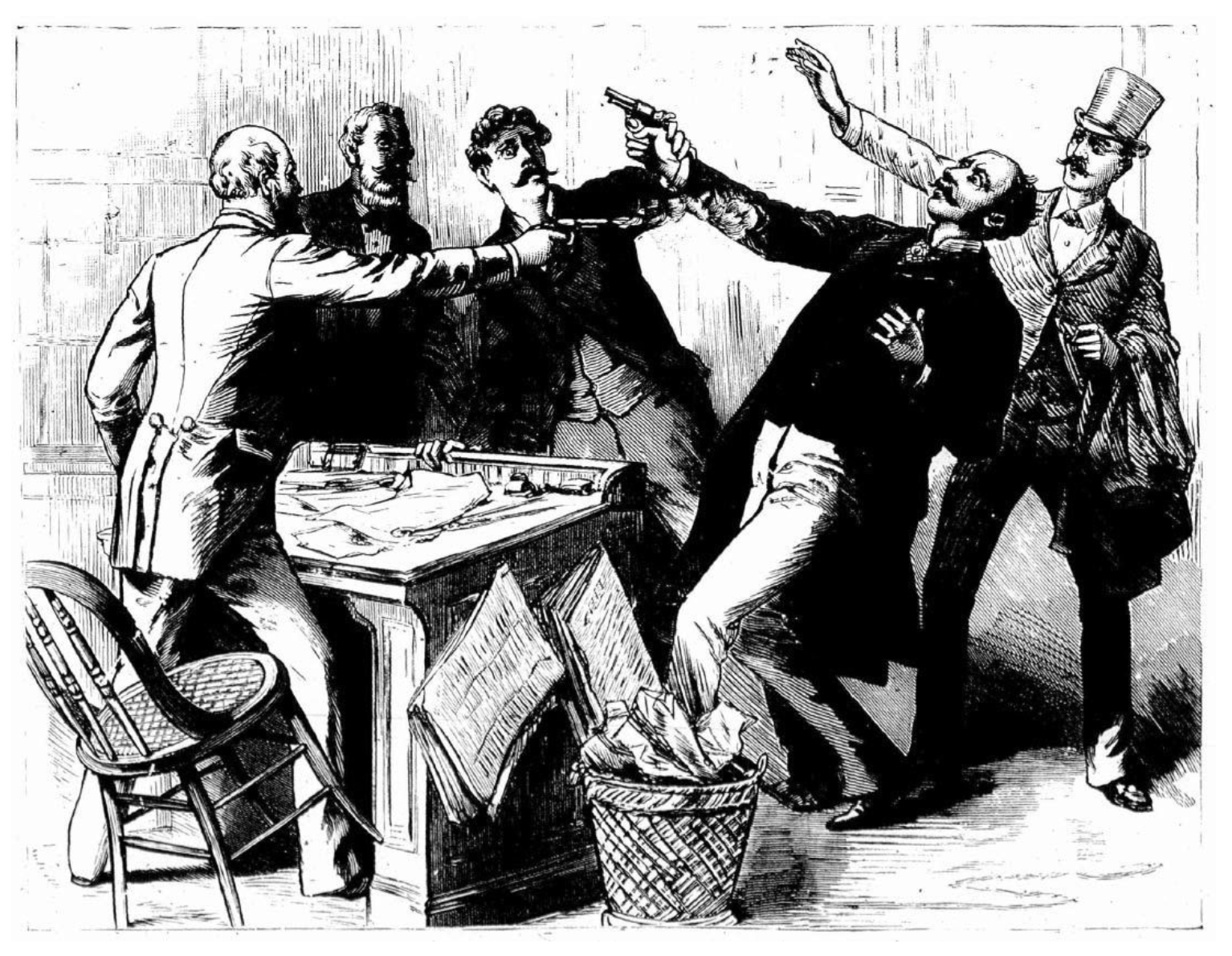
Believing that Slayback was armed—and likely intending violence—Cockerill drew a pistol and fired. Slayback was shot and killed instantly. He was forty-four years of age.
The following day’s press carried illustrations of the scene under the caption:
“The killing of Colonel Alonzo W. Slayback by John A. Cockerill, in the office of the Post-Dispatch, St. Louis, October 13th.”
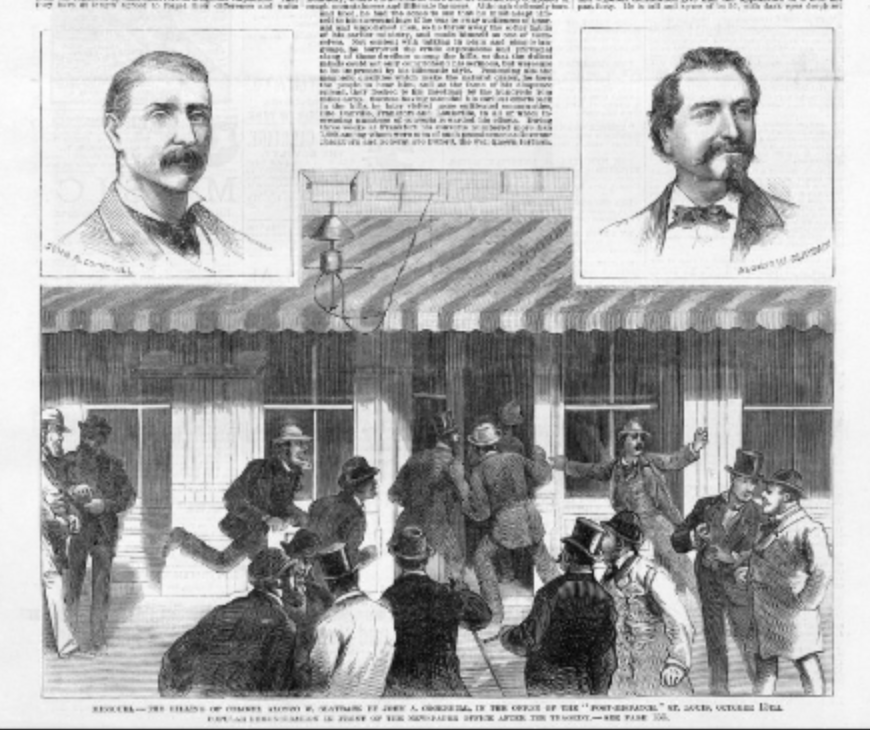 The event caused a profound sensation throughout the city. A large and excited crowd gathered before the newspaper office in the immediate aftermath of the shooting, reflecting the intensity of public feeling surrounding both the man and the circumstances of his death.
Though arrested and subjected to investigation by a grand jury, Cockerill was never brought to trial.