
 The roots of silversmithing in St. Louis stretched back to the early nineteenth century, when the city was still a frontier trading post. By the 1870s, however, the trade had evolved into a more specialized and sophisticated profession. Silversmiths no longer functioned solely as general metalworkers producing utilitarian wares; instead, they increasingly focused on decorative and luxury items—tea services, flatware, presentation pieces, and commemorative objects—often crafted in the elaborate Victorian styles popular at the time.
This transformation was driven in large part by St. Louis’s expanding middle and upper classes. The residents of neighborhoods such as those surrounding Lucas Avenue and Garrison Street—the very milieu of your Plate 71 study—expected material expressions of status and refinement. Silverware became a visible marker of domestic gentility, while jewelry signified both personal adornment and social standing. Weddings, anniversaries, and civic achievements were frequently commemorated with finely engraved silver or gold pieces.
 The jewelers of St. Louis, many of whom also worked as watchmakers, occupied prominent retail locations along major commercial corridors such as Fourth Street and Olive Street. Their shops were not merely places of transaction but displays of craftsmanship and taste. Glass cases exhibited imported diamonds, locally crafted rings, brooches, and pocket watches—many of the latter essential tools in an age increasingly governed by railroad timetables and synchronized timekeeping.
A significant portion of the city’s jewelers and silversmiths were of European origin or descent, particularly from Germany, where traditions of fine metalwork were well established. These artisans brought with them both technical skill and aesthetic sensibilities that elevated the quality of locally produced goods. At the same time, St. Louis firms often balanced imported materials and finished pieces with locally manufactured items, creating a hybrid market that catered to a wide range of customers.
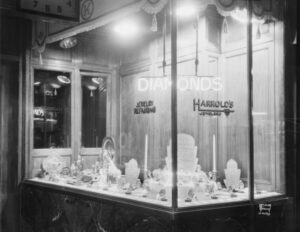
Typical Nineteenth Century Jewelry Store
 In this way, the silversmiths and jewelers of St. Louis in 1875 stood at a transitional moment. They preserved the traditions of artisanal craftsmanship while adapting to the realities of a modernizing, industrial economy. Their work not only adorned the homes and persons of the city’s residents but also embodied the broader story of St. Louis itself: a city moving from frontier origins toward established urban sophistication, where artistry and commerce met in finely worked silver and gold.