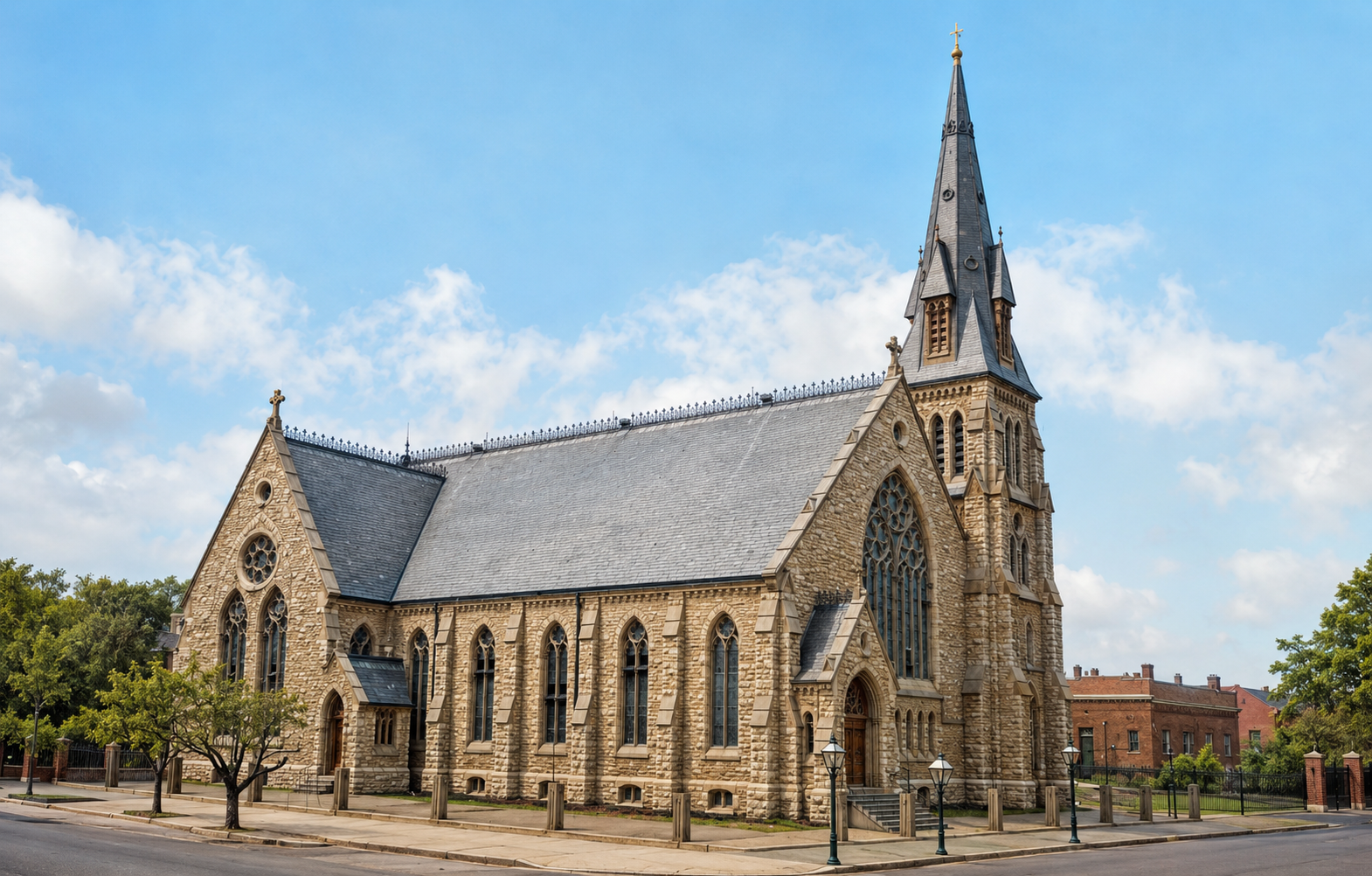
St. Georges Episcopal Church Beaumont and Chestnut Avenues
St. George’s Episcopal Church
Beaumont Avenue and Chestnut Street
Rev. R. A. Holland — Rector in 1875
Standing at the northwest corner of Beaumont and Chestnut Streets, St. George’s Protestant Episcopal Church represented one of the most enduring religious institutions within the Lucas and Garrison neighborhood in 1875. More than simply a parish church, St. George’s reflected the aspirations of a growing and increasingly prosperous section of St. Louis during the city’s explosive mid-nineteenth-century expansion. Its history intertwined education, civic ambition, financial struggle, urban growth, and the persistent effort to establish stable religious institutions on the rapidly developing western edge of the city.
The origins of St. George’s Parish emerged directly from the troubled collapse of Kemper College in 1845. Rev. E. Carter Hutchinson, president of Kemper College and a respected Episcopal educator and clergyman, suddenly found himself at the center of a displaced academic and religious community when the institution was sold for debt. Many supporters of the college hoped to retain Hutchinson within the Diocese of Missouri and sought to organize a new Episcopal parish around his leadership.
In March 1845, prominent St. Louis citizens petitioned Bishop Cicero Stephens Hawks requesting authorization for the formation of a new parish. The petition argued that the western portion of the city was rapidly increasing in population and lacked sufficient Episcopal churches to serve its residents. The names attached to the petition reveal much about the emerging social and commercial leadership of St. Louis, including businessmen, attorneys, civic figures, and future community leaders who believed institutional religion formed an essential component of urban development.
A meeting held at the St. Louis Lyceum formally organized the parish, with Rev. Hutchinson elected rector. Among the vestrymen were several men who would become notable figures within the city’s civic and business circles. The parish took the name St. George’s, reportedly inspired by a New York church associated with evangelical Episcopal traditions supported by Hutchinson.
The parish was officially admitted into the Diocesan Convention on May 13, 1846. Early services were initially held in borrowed facilities, including a public schoolhouse on Sixth Street and later a Methodist church on Fifth Street. Such temporary arrangements were common for emerging congregations in rapidly growing American cities, where religious institutions often followed residential expansion westward.
The first church building erected by the parish stood on Locust Street near Seventh and was dedicated on April 13, 1847. Although modest compared to later Episcopal churches in St. Louis, it symbolized permanence and confidence. Yet the parish soon faced significant internal tensions. Questions surrounding the administration and financial collapse of Kemper College produced lingering divisions among clergy and laity alike. These disputes intensified after an assistant minister was called to assist Rev. Hutchinson, ultimately contributing to Hutchinson’s resignation in 1852.
His successor, Rev. S. G. Gassaway of Georgetown, D.C., became rector during a critical transitional period. Gassaway was widely admired for his energy and pastoral devotion, but tragedy struck when he became one of the victims of the catastrophic explosion of the St. Louis and Alton packet shortly after departing the city in February 1854. His death deeply affected the congregation. Parishioners later erected a marble memorial tablet in his honor, reflecting the affection and esteem in which he had been held.
Throughout the 1850s and 1860s, St. George’s experienced cycles of prosperity and hardship common among urban churches during periods of rapid municipal growth. Membership fluctuated. Debt accumulated and was later retired. At one point, a number of members withdrew to form Trinity Church. Yet by 1856 the congregation had reportedly become debt free and was again growing.
The church also demonstrated the expanding institutional maturity of Episcopal life in St. Louis. In 1857 the parish purchased burial ground in Bellefontaine Cemetery for indigent communicants. In 1860 a substantial organ costing $4,300 was acquired—an indication both of liturgical ambition and increasing congregational resources.
The Civil War era brought renewed financial pressures. By 1865 the church reportedly carried debt exceeding $15,000, though this obligation was ultimately retired by 1866. St. George’s remained sufficiently important within the Diocese of Missouri that the Diocesan Convention which elected Bishop Charles F. Robertson in 1868 was held there.
The present church building at Beaumont and Chestnut emerged from this period of recovery and expansion. In 1871 the congregation purchased the site for $18,650, and construction soon followed. The earlier Locust Street church property was sold in 1872, marking a decisive westward relocation aligned with the movement of many affluent St. Louis residents toward Lucas Place, Washington Avenue, and the growing western residential districts.
By 1875, St. George’s stood firmly within one of the city’s most distinguished emerging neighborhoods. Surrounded by businessmen, industrialists, professionals, and civic leaders, the church occupied both a geographic and cultural position at the center of an evolving urban elite community.
Rev. R. A. Holland served as rector during this later nineteenth-century phase of parish life, inheriting an institution already deeply woven into the religious and civic history of St. Louis. Under his leadership, St. George’s continued the Episcopal tradition of liturgical worship, charitable activity, and institutional stability that had characterized the parish since its founding thirty years earlier.
The story of St. George’s Episcopal Church reveals more than the history of a single congregation. It illustrates how churches acted as anchors for community formation in nineteenth-century St. Louis. Religious institutions followed the movement of population, reflected economic optimism and instability, fostered educational and charitable efforts, and connected prominent residents into networks of civic influence that helped shape the future of the city itself.
LucGar Reflective Addendum
St. George’s Episcopal Church reminds us that the development of a city involves far more than streets, commerce, and architecture. Institutions such as churches created the moral, educational, and social framework that allowed neighborhoods to become true communities. The men and women who established and sustained St. George’s believed that civic prosperity required spiritual and institutional stability as well.
The parish endured financial crises, leadership transitions, urban migration, and even personal tragedy, yet persisted through decades of profound change in St. Louis history. Its survival reflects the determination of citizens who viewed community-building as a shared responsibility.
Today, many urban neighborhoods struggle with fragmentation and institutional decline. The story of St. George’s offers a reminder that healthy cities are sustained not merely by economics, but by enduring commitments to shared values, service, education, faith, and civic cooperation.