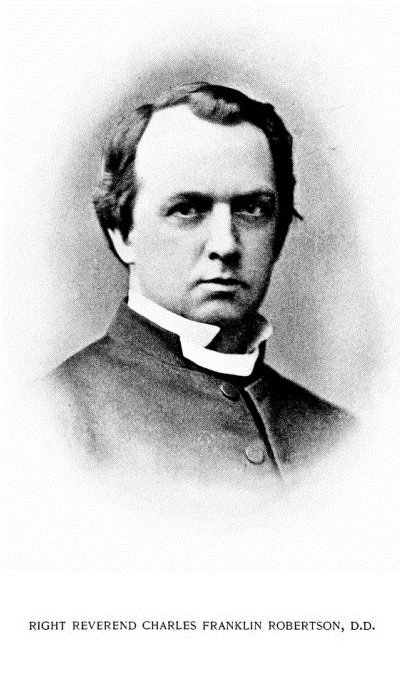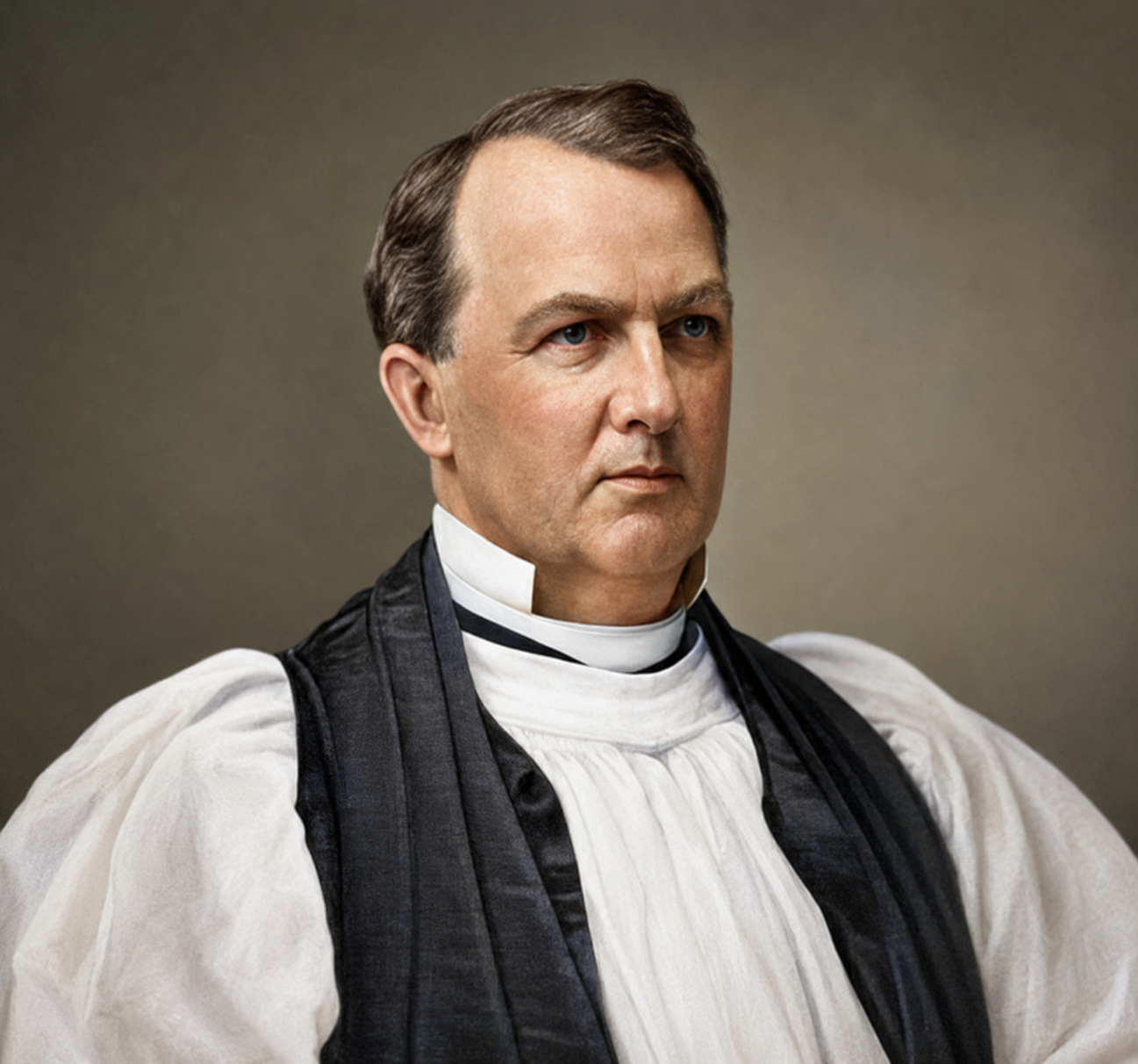
Rt. Rev. Bishop Charles F. Robertson
2727 Chestnut Avenue
Bishop, Episcopal Diocese of Missouri
Office: 204 North 5th Street

Among the most influential religious leaders residing within the Lucas and Garrison neighborhood in 1875 was the Right Reverend Charles Frederick Robertson, second bishop of the Episcopal Diocese of Missouri. Though still a comparatively young man in that year, Robertson already stood at the center of one of the most important periods of institutional growth in the history of the Episcopal Church in Missouri. His life and work reveal not merely the role of a clergyman, but that of an organizer, educator, reform-minded civic participant, and architect of religious expansion during the explosive post–Civil War development of St. Louis.

Born in New York City on March 2, 1835, Robertson came from a family long established in the city. His early life was not initially directed toward the ministry. Educated in private schools, he was originally expected to follow his father into mercantile pursuits and for several years worked within the commercial world. Yet the intellectual and spiritual currents of the mid-nineteenth century ultimately redirected his course. Entering Yale University in his twentieth year, Robertson pursued classical studies with distinction and graduated with honors in 1859.

Immediately afterward he entered the General Theological Seminary of the Protestant Episcopal Church in New York, preparing for holy orders during one of the most turbulent moments in American history. Ordained in June 1862 in the midst of the Civil War, he accepted the rectorship of St. Mark’s Church in Malone, New York. Although larger and more prestigious parishes repeatedly sought him, Robertson remained there until 1868, suggesting a temperament marked less by ambition than by steadiness and disciplined pastoral work.

That same year his career changed dramatically. On September 5, 1868, the convention of the Episcopal Diocese of Missouri elected him bishop of the diocese, despite his youth and relative obscurity beyond New York ecclesiastical circles. Consecrated at Grace Church on October 25, 1868, Robertson became one of the youngest diocesan bishops in the Episcopal Church.

When he arrived in St. Louis in November 1868, the city was entering one of the great transformative eras in its history. Railroads, manufacturing, immigration, river commerce, and westward expansion were reshaping St. Louis into a major national metropolis. Churches struggled to keep pace with explosive urban growth, shifting populations, and financial instability. Robertson immediately threw himself into the challenge with extraordinary energy.

His first Sunday in St. Louis set the tone for the years ahead. He preached at Christ Church Cathedral in the morning, at Trinity Church in the afternoon, and at St. Georges Episcopal Church in the evening. The pace reflected both physical stamina and a determination to unify and expand a diocesan structure that had previously been fragile and geographically scattered.

The transformation accomplished during his administration was remarkable. At the time of his election only eighteen clergymen participated in choosing the bishop. By the mid-1870s, more than sixty clergy were attached to the diocese. More than seventy churches had been constructed across Missouri during his episcopate. Congregations burdened by enormous debts in the late 1860s had largely stabilized financially, while communicant membership multiplied several times over.

The growth in St. Louis itself was especially striking. In 1868 the Episcopal Church maintained only five parishes within the city. Within a decade that number had expanded to fifteen churches and missions holding regular services. Such growth reflected not merely population increases, but Robertson’s systematic commitment to institution-building. He recognized that churches required schools, charitable societies, missions, trained clergy, and administrative organization if they were to endure in a rapidly industrializing city.

His interests extended well beyond ecclesiastical administration. Robertson belonged to the Missouri Historical Society and the Social Science Association, reflecting the broader intellectual culture of educated nineteenth-century Protestant leadership. He also served as corresponding secretary in Missouri for the National Conference of Charities and Corrections, linking him to emerging national movements addressing poverty, public welfare, prisons, and social reform during the Gilded Age.

Education likewise occupied a central place in his work. Robertson served as president of the board of trustees of Nashotah House Theological Seminary and oversaw numerous educational and charitable institutions connected with the Episcopal Diocese of Missouri. In an age when churches often provided much of the social safety net, bishops like Robertson exercised influence reaching far beyond Sunday worship.

His marriage in 1865 to Rebecca Duane further connected him to prominent early American civic and ecclesiastical traditions. Her great-grandfather had been the first mayor of New York City after the American Revolution and one of the organizers of the Episcopal Church in the new republic. Such lineage reinforced the sense that Robertson represented a continuation of established eastern Episcopal leadership transplanted into the growing Mississippi Valley.

Yet despite these eastern roots, Robertson became deeply identified with Missouri and St. Louis. His residence on Chestnut Avenue placed him physically within the evolving Lucas and Garrison neighborhood during a period when many of the city’s civic, commercial, and religious leaders clustered there. The neighborhood itself reflected the interconnected world of late nineteenth-century St. Louis leadership—industrialists, financiers, clergy, educators, and reformers living within walking or carriage distance of one another while collectively shaping the future of the city.

Bishop Robertson’s presence within the Lucas and Garrison landscape also strengthens one of the recurring themes emerging throughout this project: the powerful institutional networks that undergirded nineteenth-century urban growth. Churches were not isolated spiritual enclaves. They served as engines of education, charity, civic organization, moral reform, and social cohesion. Men like Robertson stood at the center of those networks, linking local congregations to national movements and helping define the cultural character of St. Louis during one of its great eras of expansion.