
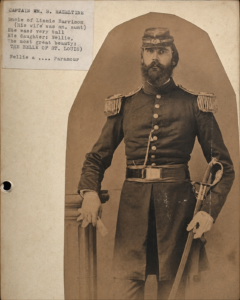
 Captain William B. Hazeltine
2731 Pine Avenue
William B. Hazeltine — Hides and Leather
717 North Main Street
Captain, Engineer Corps, Missouri Volunteer Militia
Among the prosperous merchant households occupying the western edge of St. Louis in 1875, Captain William B. Hazeltine represented a distinctive type of post–Civil War civic figure whose life bridged commerce, military service, and the rapidly expanding industrial economy of the Mississippi Valley. Though remembered today largely through the later fame of his daughter Nellie Hazeltine Paramore, Captain Hazeltine himself belonged to the important mercantile generation that helped transform St. Louis from a frontier river city into one of the great commercial and manufacturing centers of nineteenth-century America.
By 1875 Hazeltine resided at 2731 Pine Avenue within the increasingly fashionable residential district developing west of downtown St. Louis. His business interests, however, remained firmly tied to the old riverfront commercial corridor where he operated in the hides and leather trade at 717 North Main Street.
The leather industry occupied a far more important position in nineteenth-century urban life than is often appreciated today. Before the development of modern synthetic materials, leather was essential to nearly every aspect of transportation, manufacturing, agriculture, and commerce. Saddles, harnesses, boots, trunks, machinery belts, carriage fittings, industrial drive systems, military equipment, and countless everyday goods depended upon processed leather.
St. Louis was uniquely positioned to dominate portions of this trade. The city stood at the crossroads of:
-
western cattle production,
-
Mississippi River transportation,
-
eastern manufacturing markets,
-
and the expanding railroad network of the American interior.
Raw hides moved eastward from cattle regions across Missouri, Kansas, Texas, and the western territories, arriving in St. Louis for processing, storage, sale, and redistribution. River commerce and rail transportation converged along the levee district, where merchants like Hazeltine operated amid warehouses, commission houses, tobacco firms, hardware dealers, grain merchants, and freight depots crowded tightly along the Mississippi waterfront.
North Main Street in particular formed part of the dense commercial infrastructure that made St. Louis one of the great wholesale centers of the nation during the decades following the Civil War. The district was noisy, crowded, and intensely active. Freight wagons rattled continuously across the streets while steamboats unloaded cargo from throughout the Mississippi Valley. Railroads increasingly tied the city to national markets, allowing merchants to distribute goods rapidly throughout the growing West and South.
The leather trade itself demanded considerable business skill. Hides were bulky, perishable commodities vulnerable to transportation delays, spoilage, market fluctuations, and changing industrial demand. Success required extensive commercial relationships, organizational ability, and access to transportation networks stretching across multiple states and territories. Hazeltine’s prosperity suggests that he had mastered these complexities successfully enough to establish himself among the city’s respected merchant class.
Yet commerce alone does not explain the title “Captain” permanently attached to his name.
Civil War records reveal that Hazeltine served during the war as:
Captain William B. Hazeltine, Engineer Corps, Missouri Volunteer Militia.
This discovery places him directly within the Union military structure that preserved federal authority in Missouri during one of the most unstable periods in the state’s history. Missouri’s wartime experience was marked by divided loyalties, guerrilla warfare, internal violence, and political instability. The Missouri Volunteer Militia became essential to maintaining Union control and protecting transportation systems, infrastructure, and urban order throughout the state.
Hazeltine’s assignment within the Engineer Corps is especially revealing. Military engineers were responsible for technical and logistical operations involving transportation systems, fortifications, mapping, bridges, defensive works, communications, and military infrastructure. Such appointments often went to men possessing organizational skill, reliability, and significant standing within the community.
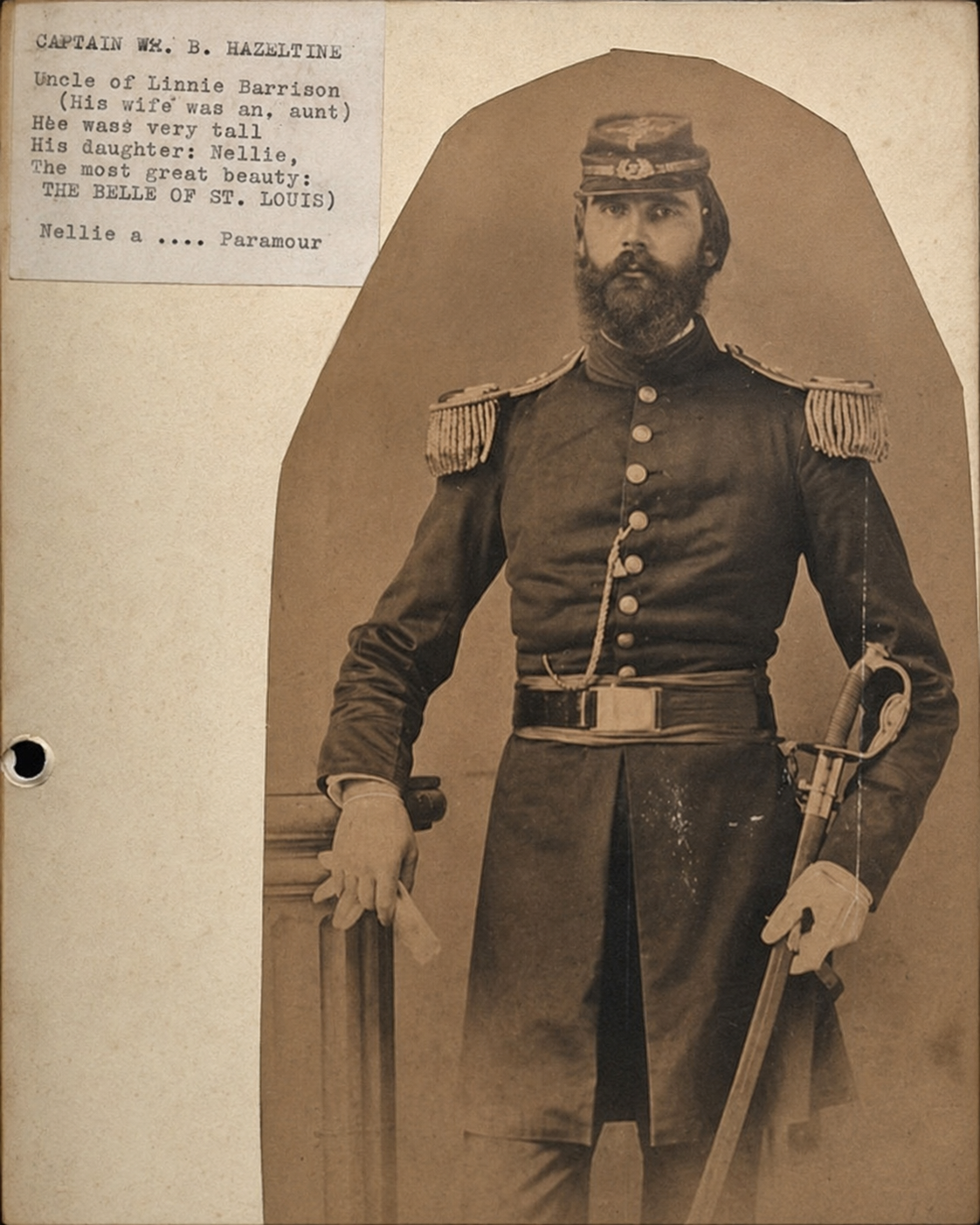
A surviving wartime portrait of Hazeltine presents him in full Union officer’s uniform, sword at his side, projecting the stern confidence characteristic of Civil War-era volunteer officers. The image survives with a remarkable family annotation identifying him simply as:
“Captain W. B. Hazeltine.”
The notation further observes:
“He was very tall.”
The simple comment unexpectedly humanizes the formal military image and preserves a detail remembered by descendants decades after the war had passed.
The annotation also contains another revealing line:
“His daughter: Nellie, The Belle of St. Louis.”
That brief statement ultimately explains much about the continuing historical memory of the Hazeltine family. Though William Hazeltine achieved success through commerce and military service, his household became culturally significant because of the extraordinary public prominence later attained by his daughter Nellie.
Still, the elder Hazeltine’s importance should not be overshadowed by later social mythology. Men such as William B. Hazeltine formed the practical commercial backbone of postwar St. Louis. Their wartime loyalty, business networks, transportation connections, and industrial activity helped fuel the city’s astonishing growth during the late nineteenth century.
The Hazeltine residence on Pine Avenue illustrates the larger westward migration of prosperous merchants away from the increasingly crowded commercial riverfront toward newer residential districts populated by the city’s emerging upper-middle and upper classes. Families such as the Hazeltines helped define the social and economic character of these developing neighborhoods, which combined commercial wealth with growing cultural sophistication.
Through Captain William B. Hazeltine can be seen several important dimensions of postwar St. Louis:
-
Civil War Unionism,
-
riverfront commerce,
-
industrial expansion,
-
western trade,
-
elite residential migration,
-
and the emergence of stable mercantile households whose influence extended well beyond the countinghouse.