Patterson, Robert D.
2828 Locust Street

Born: December 12, 1831

Died: December 15, 1901 (age 70)

Buried: Bellfontaine Cemetery
St. Louis, Missouri

Robert D. Patterson & Company
Stationers and Booksellers
300–302 North Main Street

Robert D. Patterson occupied an important position within the commercial and intellectual infrastructure of nineteenth-century St. Louis. Though not as publicly celebrated as railroad magnates, industrialists, or political leaders, Patterson’s business helped supply the essential tools through which the rapidly growing city conducted commerce, education, law, and communication. In an age before typewriters, telephones, and digital technology, the city depended upon paper, books, ledgers, printed forms, ink, and stationery. Firms such as Robert D. Patterson & Company quietly enabled the daily operation of urban life.

By 1875 Patterson lived at 2828 Locust Street within the Lucas and Garrison neighborhood while operating his wholesale stationery and bookselling establishment at 300 and 302 North Main Street in the mercantile center of St. Louis. Gould’s Directory identified the firm as “stationers and booksellers,” but surviving advertisements and trade descriptions reveal a large and sophisticated enterprise serving both the city and the broader Mississippi Valley.

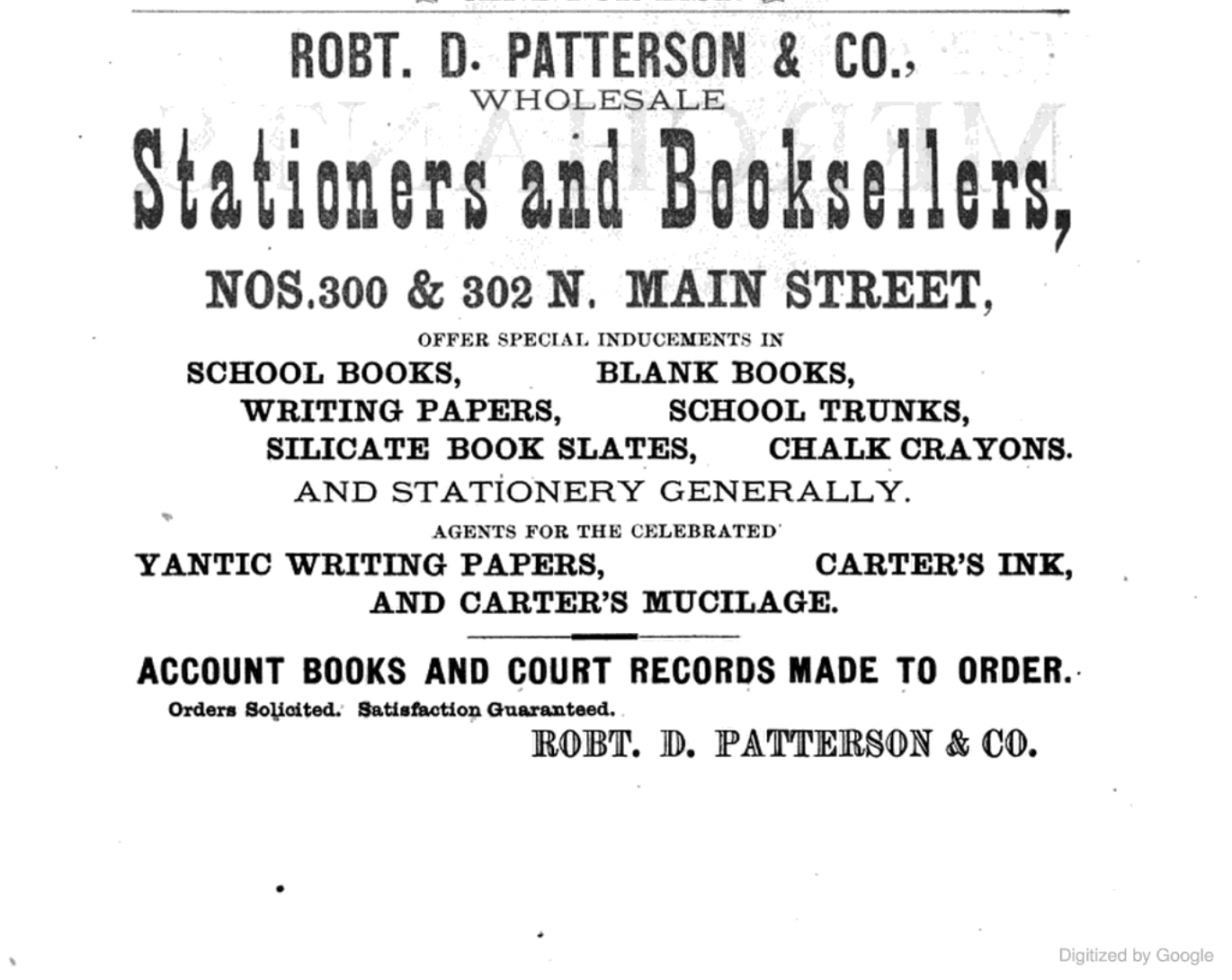
An advertisement for Robert D. Patterson & Company promoted wholesale school books, blank books, writing papers, school trunks, slates, chalk crayons, and “stationery generally.” The firm also specialized in account books and court records made to order — products critical to the legal and commercial systems of the era. Agencies for celebrated writing papers and Carter’s Ink further demonstrated Patterson’s participation in a national distribution network linking eastern manufacturers to western markets.

A contemporary trade publication described Patterson as a “well-known and popular stationer” who had been engaged in the paper and stationery business since the age of fourteen. The article praised the company’s “fair dealing, unremitting attention to business, and liberal treatment of customers,” declaring that the firm had built a business “second to no house in the Mississippi Valley.” Such language reflected the civic pride common in nineteenth-century St. Louis promotional literature, but it also suggests the significant regional reputation Patterson had established.

The stationery trade played a far greater role in urban development than modern observers often recognize. Every expanding institution in St. Louis required paper systems to function. Schools needed textbooks and writing supplies. Attorneys and courts depended upon bound record books and legal forms. Railroads required invoices, manifests, and ledgers. Merchants maintained complex account books to track inventory and credit. Government offices generated endless correspondence and documentation. The physical paper infrastructure of the nineteenth century formed the nervous system of the modernizing city.

Patterson’s North Main Street location placed him near the commercial riverfront and within the wholesale district that connected St. Louis to the expanding American West. The city’s position as a distribution hub meant that wholesale firms like Patterson’s served customers far beyond Missouri. Books, paper goods, and stationery products likely moved from his establishment into small towns, schools, courthouses, and businesses throughout the Mississippi Valley and western territories.

The surviving directory listing also identifies Patterson’s business partner as Irving McGowan, illustrating the collaborative nature of many St. Louis commercial enterprises during this period. Partnerships built upon reputation, trust, and long-standing business relationships formed much of the foundation of the city’s economic growth.

Robert D. Patterson was born on December 12, 1831, and died on December 15, 1901, at the age of seventy. Like many influential residents connected to the Lucas and Garrison neighborhood, he was buried at Bellefontaine Cemetery, the resting place of numerous civic leaders, industrialists, merchants, and professionals who shaped nineteenth-century St. Louis.

Though his work produced few monuments of stone or iron, Patterson helped build the documentary framework of a great American city. The ledgers, schoolbooks, correspondence, legal records, and commercial documents supplied through his business recorded the growth of St. Louis during one of the most transformative periods in its history. In many respects, stationers like Robert D. Patterson preserved the written memory of the nineteenth century itself.