
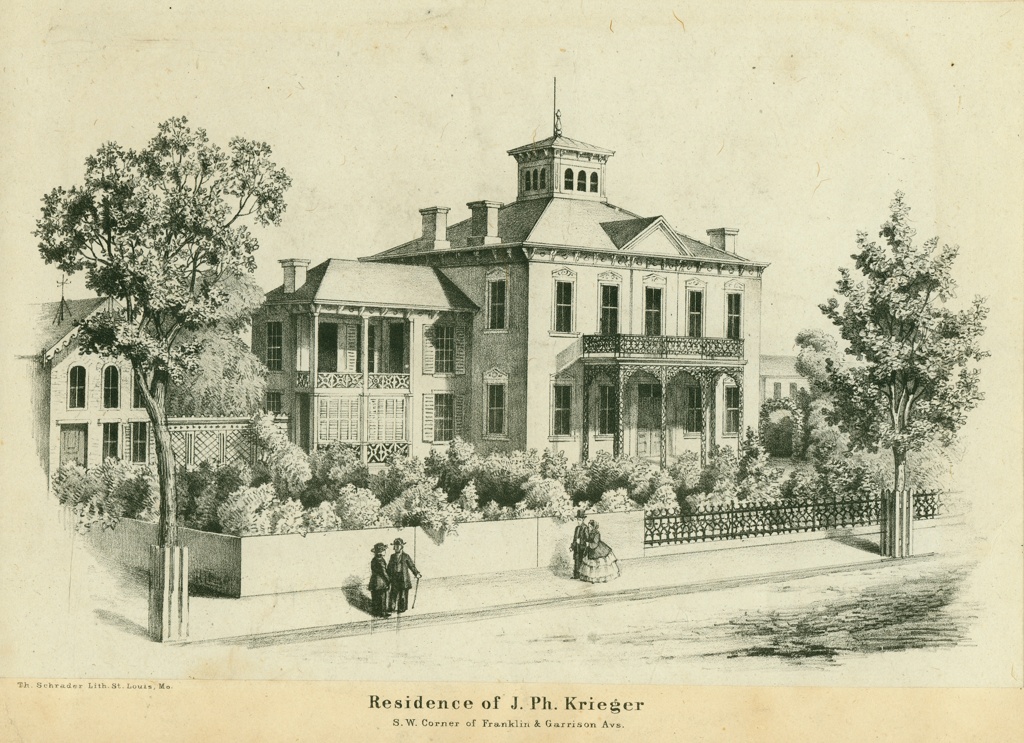
Krieger Residence - 815 Garrison Avenue
John Phillip Krieger
815 Garrison Avenue
Born: September 17, 1819
Wiesbaden, Hesse, Germany
Died: January 31, 1894 (age 74)
St. Louis, Missouri
Buried: Calvary Cemetery
St. Louis, Missouri
Spouse: Sophie Langenohl, Married March 2, 1842
Bierstadt, Wiesbaden, Hesse-Nassau, Prussia, Germany
The Krieger Family Household
815 Garrison Avenue, St. Louis (Plate 71, 1875)
Among the residences of Garrison Avenue, few illustrate more clearly the overlapping worlds of finance, commerce, and family enterprise than the household of the Krieger family at 815 Garrison. What appears at first glance to be a simple directory listing unfolds, upon closer examination, into a tightly connected network of banking authority, commercial activity, and familial influence centered on one address.
By 1875, the Krieger name was firmly embedded in the financial life of St. Louis. The Broadway Savings Bank, organized in 1869 and located at the corner of Broadway and Carr Streets, stood as a substantial institution with a capital of $300,000 and a significant surplus. Its leadership reveals the central role of the family: J. P. Krieger, Sr. served as vice president, while J. P. Krieger, Jr., identified in directories as J. Philip Krieger, held the critical position of cashier. In the structure of nineteenth-century banking, the cashier was no mere clerk, but the operational head of the institution, responsible for its daily financial dealings and entrusted with the confidence of its depositors.
This concentration of authority within a father–son relationship suggests that the Broadway Savings Bank was not simply a place of employment for the Kriegers, but an institution in which they exercised significant control. The presence of another resident of 815 Garrison, John B. Krieger, employed as a messenger at the Biddle Market Savings Bank, further indicates that banking was not an isolated occupation within the household, but part of a broader family alignment with the financial sector.
Yet the economic reach of the Krieger household extended beyond formal finance. Also residing at 815 Garrison was John P. Krieger, proprietor of a saloon located at 701 Broadway. This establishment placed the family not only within the structured world of savings institutions, but also within the more fluid and cash-driven environment of urban commercial life. Broadway, one of the principal arteries of the city, connected these spheres physically as well as economically. The proximity of the saloon to the banking district suggests a family presence that bridged different layers of St. Louis society—from wage earners and tradesmen to depositors and investors.
Taken together, the occupants of 815 Garrison represent a striking example of a diversified household economy in post–Civil War St. Louis. Within a single residence were men engaged in financial management, clerical banking work, and retail liquor trade. Such an arrangement reflects not only familial cooperation, but also a strategic positioning across complementary sectors of the urban economy.
The later history of the Broadway Savings Bank casts a retrospective shadow over this household. In 1879, the institution suspended payment, and contemporary accounts and legal proceedings placed responsibility, at least in part, upon its cashier, J. Philip Krieger, Jr. Allegations of mismanagement and irregularities emerged, suggesting that the trust placed in the bank’s officers had been compromised. The collapse of the bank transformed what had been a position of prominence into one of public scrutiny, and within a short time Krieger’s life came to a tragic end.
In this light, the residence at 815 Garrison Avenue assumes a deeper historical significance. It was not merely the home of a banker, or even of a family engaged in multiple trades, but a focal point of ambition, enterprise, and ultimately vulnerability within the rapidly developing economy of St. Louis. The Krieger household embodies both the opportunities and the risks of the period—where family networks could elevate individuals into positions of influence, yet also concentrate the consequences when those structures failed.
As part of the broader Garrison Avenue landscape, the Kriegers stand as a compelling reminder that behind the respectable facades of these residences were lives deeply intertwined with the financial and commercial currents of their time. Their story, rooted in one address, reaches outward into the institutions and streets that defined the city itself.
J. Philip Krieger, Jr.
Residence: 815 Garrison Avenue
Most likely identification: Cashier of the Broadway Savings Bank of St. Louis
Later notoriety: Central figure in the failure of that bank
J. Philip Kreiger of 815 Garrison Avenue appears, on present evidence, to be the same man more often styled in period sources as J. Philip Krieger, Jr. The address is directly tied to that name in a contemporary annual report snippet, which lists “J. Philip Krieger, Jr.” at 815 Garrison Avenue. A later city directory also places a Krieger at that address, though the OCR there is imperfect.
The strongest identification for him is banking. Court records state that when the Broadway Savings Bank suspended payment on May 22, 1879, J. Philip Krieger, Jr. “was, and had been since its organization in 1869, its cashier.” Another appellate case likewise states that he entered upon his duties under a bond dated February 13, 1869, and continued to act as cashier through the 1870s.
That makes him an unusually interesting Plate 71 figure. In 1875 he would have stood not merely as a resident of a fashionable Garrison address, but as a man tied to the city’s financial machinery. A cashier in a nineteenth-century savings bank was far more than a clerk; he was one of the visible operating officers of the institution, entrusted with deposits, accounts, and daily confidence. His residence on Garrison fits the broader pattern you keep finding on Plate 71: men whose homes projected stability, status, and participation in the commercial life of St. Louis. This part is an inference from his office and address rather than a direct statement by any one source.
But Krieger’s later story turned dark. Contemporary reporting outside Missouri summarized the collapse of the Broadway Savings Bank by saying that false accounts had hidden losses and that the institution had been robbed of a very large sum by the cashier, Philip Krieger, Jr., son of the bank’s president. One legal opinion preserves a narrower, more careful version of the scandal: it states that, before the suspension, Krieger had allowed a depositor named Goldsoll to overdraw by $3,000, causing loss to the bank. (digmichnews.cmich.edu)
The family dimension is also important. Financial press coverage identified Philip Krieger, Sr. as president of the defunct Broadway Savings Bank, and one newspaper account specifically called the cashier, Philip Krieger, Jr., the president’s son. That makes 815 Garrison part of a larger father-son banking story rather than an isolated individual profile. (Newman Numismatic Portal)
His fall from prominence seems to have been rapid and public. In January 1881, multiple newspapers reported that J. Philip Krieger, Jr., once considered one of the prominent men of St. Louis and the former cashier of the failed bank, was found dead in his room. (Hoosier State Chronicles)